
Your father passed away last month. You assumed he had a will somewhere—he always talked about “having things handled.” But after searching through every drawer and filing cabinet, you’ve found nothing. No trust. No will. No instructions. Now you’re facing a question thousands of California families confront each year: what happens to his estate when there’s no plan?
When someone dies without a will in California, their estate goes through probate and is distributed according to California’s intestate succession laws under Probate Code §§6400-6414. The state essentially writes a will for your loved one based on a predetermined formula that prioritizes spouses, children, and then extended family—regardless of what your father may have actually wanted. The Legacy Lawyers help families navigate this complex legal process, protecting their rights throughout California probate proceedings.
This article explains exactly how California intestacy laws determine who inherits, how the probate process unfolds when there’s no will, what timeline you should expect, and what legal rights you have as an heir.
Understanding Intestate Succession in California
When a California resident dies without a valid will, they die “intestate.” This means California law—not the deceased person’s wishes—controls who receives their assets. The rules governing this distribution are found in California Probate Code §§6400-6414, which establish a rigid hierarchy of inheritance.
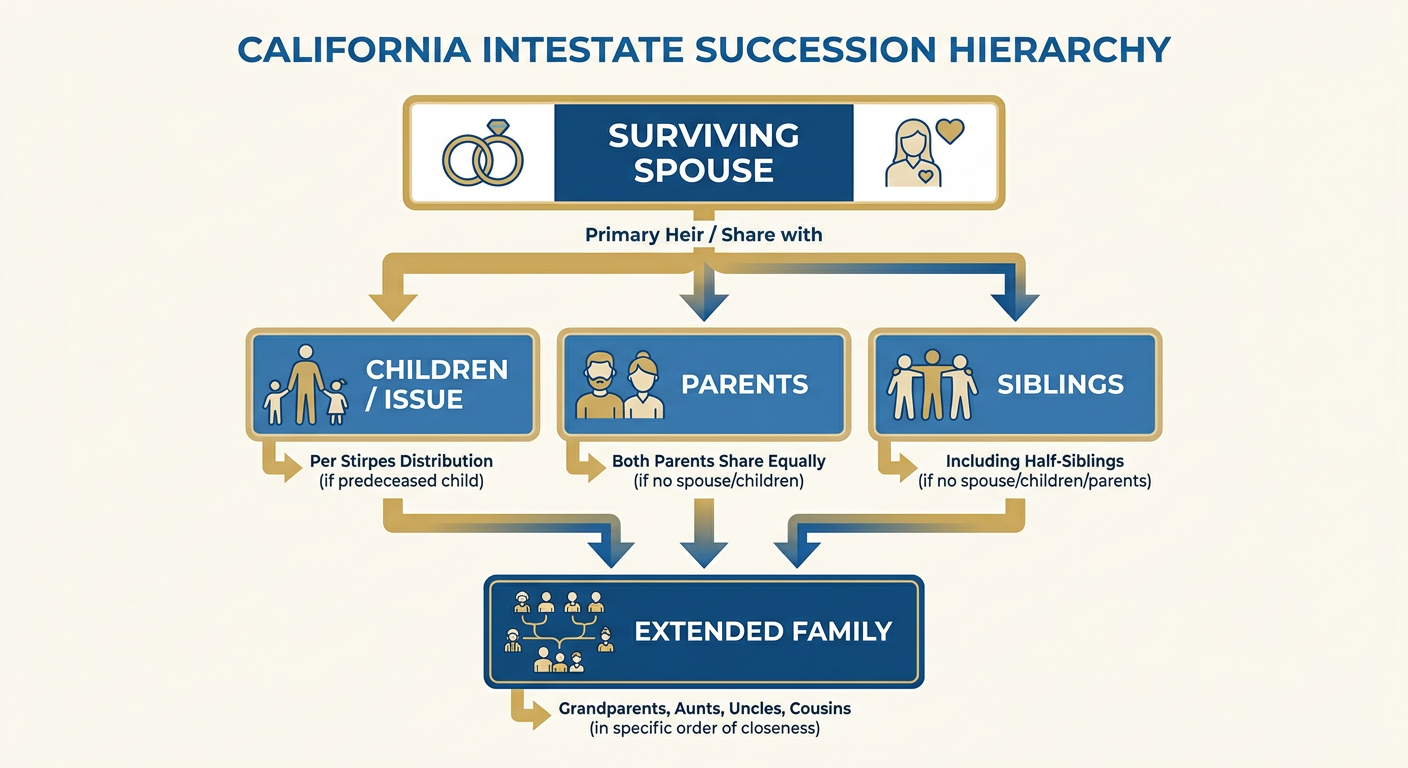
Under California Probate Code §6401, the surviving spouse’s share depends on whether the deceased had children, parents, or siblings. If your father was married and you’re his only child from that marriage, his surviving spouse (your mother) would receive the entire estate. But if you’re his child from a previous relationship, the distribution becomes more complex—the surviving spouse might receive only one-half or one-third of the estate’s community property and a portion of separate property.
The California Supreme Court addressed the importance of proper intestate distribution in Estate of Dye (2001) 92 Cal.App.4th 966, emphasizing that courts must strictly follow statutory inheritance rules rather than considering what the decedent might have preferred. This case illustrates a fundamental truth about dying intestate: the law doesn’t care about verbal promises, family expectations, or what seemed “fair.”
Who Inherits Under California Intestacy Laws?
California Probate Code §6402 establishes the order of inheritance when there’s no surviving spouse:
- Children and their descendants inherit first, with the estate divided equally among them
- Parents inherit if the deceased had no children
- Siblings and their descendants inherit if there are no surviving parents
- Grandparents inherit next, followed by aunts, uncles, and cousins
- The State of California claims the estate only if absolutely no relatives can be found (escheat)
Consider this scenario: Your father divorced your mother years ago and never remarried. He had two children—you and your brother. Under intestacy, you and your brother would each receive exactly 50% of the estate. But what if your brother predeceased your father and had three children of his own? Under California Probate Code §240, those grandchildren would split their father’s share, each receiving approximately 16.67% of the total estate while you still receive 50%.
Blended families face particular challenges. If your father remarried and his second wife survives him, California Probate Code §6401(c) gives her significant rights to both community property and a portion of separate property—potentially reducing what you, as a child from the first marriage, ultimately receive.
Your Rights and Options as an Heir
As a potential heir in an intestate estate, California law grants you specific rights that you can exercise to protect your inheritance. Understanding these rights is essential, especially when family dynamics complicate the process.
The right to petition for probate: Under California Probate Code §8000, any interested person—including an intestate heir—may petition the court to open probate. You don’t have to wait for someone else to take action. If no one has filed within 30 days of death, you can file yourself and potentially be appointed as the estate administrator.
The right to information: Once probate opens, California Probate Code §8110 requires that all known heirs receive notice of the proceedings. You’re entitled to receive the petition, inventories, accountings, and all court filings. If the administrator isn’t providing these documents, you can petition the court to compel disclosure.

The right to object: You can challenge who is appointed as administrator, object to the inventory and appraisal, dispute claims against the estate, and contest proposed distributions. California Probate Code §8502 gives heirs standing to file objections throughout the probate process.
The right to an accounting: Under California Probate Code §10900, the administrator must provide a detailed accounting of all estate assets, income, expenses, and distributions. You can petition for a formal accounting if you believe assets are being mismanaged or hidden.
Critical Deadlines You Must Know
California probate operates on strict timelines. Missing a deadline can waive your rights permanently:
- Creditor claims: Must be filed within four months of administrator appointment or 60 days of notice to creditor, whichever is later (Probate Code §9100)
- Objections to administrator: Must be filed before the hearing on the petition for appointment
- Spousal property petition: A surviving spouse must act within 30 days of notice to preserve certain rights
Evidence preservation matters too. If you suspect missing assets or wrongdoing, document everything immediately. Bank statements, property records, and correspondence can disappear once an unsympathetic administrator takes control.
Navigating intestate probate without legal guidance puts your inheritance at risk. If you’re an heir facing a California probate without a will, The Legacy Lawyers can help. We serve clients throughout California from offices in Irvine, Los Angeles, Torrance, Inland Empire, San Diego, San Francisco, and Sacramento.
How The Legacy Lawyers Help Families Through Intestate Probate
When there’s no will, the probate process becomes more adversarial. Family members who expected to inherit may discover the law sees things differently. Stepchildren who were raised by the deceased may inherit nothing under intestacy. A surviving spouse may claim more than biological children anticipated. These conflicts require experienced legal representation.
The Legacy Lawyers team represents heirs throughout California in intestate probate matters. Our attorneys—including Phillip C. Lemmons, recognized by Super Lawyers, and attorneys Nikolas S. Antzoulatos, Maksim Lamash, and Amie Jacoby—understand that these cases are never just about legal technicalities. They’re about families, grief, and financial security.
We help clients protect their beneficiary rights, challenge improper administrator appointments, recover missing or hidden assets, and ensure the estate is distributed according to California law. Our firm has earned recognition from Martindale Hubbell, Avvo, and Expertise for our work in probate and estate litigation.
From Los Angeles to San Diego, San Francisco to Sacramento, we provide statewide representation for families navigating the emotional and legal complexities of intestate succession. We know this is personal—and we treat it that way.
How Long Does Probate Take Without a Will in California?
Without a will, probate typically takes 12 to 18 months in California, though complex estates or contested matters can extend this timeline significantly. The process must follow statutory requirements that can’t be shortened, regardless of how straightforward the estate appears.
Under California Probate Code §8461, the court must establish who has priority to serve as administrator—and this priority list differs from the executor priority in cases with a will. The surviving spouse has first priority, followed by children, grandchildren, and other heirs. Disputes over who should serve as administrator can add months to the process before any actual estate administration begins.
The required four-month creditor claim period (Probate Code §9100) cannot be waived, and the court won’t approve final distribution until this period expires. Additionally, accounting matters often become contentious in intestate estates, particularly when heirs distrust whoever is administering the estate.
What If There’s a Dispute About Who Qualifies as an Heir?
Intestate succession seems straightforward until family secrets surface. A previously unknown child claims inheritance rights. Someone disputes whether a marriage was legally valid. A family questions whether an adoption terminated biological inheritance rights.
California courts have addressed these disputes in cases like Estate of Burden (2007) 146 Cal.App.4th 1021, which clarified how courts determine parentage for inheritance purposes. Under California Probate Code §6453, a parent-child relationship can be established through various means including biological testing, court orders, or acknowledgment—and each of these pathways has specific requirements.
If you believe someone is falsely claiming heir status, or if your own status as an heir is being challenged, you need legal representation immediately. The court will hold a hearing to determine heirship under Probate Code §11700, and the outcome directly impacts how the estate is divided.
Can a Surviving Spouse Avoid Full Probate?
In some cases, a surviving spouse can use simplified procedures to claim their share of community property without a full probate administration. California Probate Code §13650 allows a surviving spouse to petition for a court order confirming that community property passes to them without administration.
This spousal property petition is faster and less expensive than full probate, but it only applies to community property and certain quasi-community property. The deceased spouse’s separate property still requires probate administration—and that’s where children and other heirs come into the picture.
Additionally, California’s small estate procedures under Probate Code §§13100-13115 may apply if the estate’s value falls below $184,500 (as of 2024). These affidavit procedures can bypass formal probate entirely, but strict requirements apply and disputes among heirs may still force the matter into court.
What Happens to Real Property Without a Will?
Real estate complicates intestate probate significantly. Unlike bank accounts that can sometimes transfer through simplified procedures, California real property almost always requires either a full probate or a spousal property petition to transfer title.
Under California Probate Code §7001, title to real property passes to heirs at the moment of death—but they can’t sell or refinance until probate establishes their ownership legally. This creates a frustrating limbo where heirs technically own the property but can’t do anything with it until the court confirms their status.
Multiple heirs inheriting real property often face difficult choices. Does everyone want to keep the property? Can one heir buy out the others? What if heirs can’t agree? The court may ultimately order a partition sale under Code of Civil Procedure §872.210, forcing a sale and division of proceeds—often at below-market prices.
FAQ
How much does probate cost when there’s no will in California?
Probate without a will costs approximately the same as probate with a will—statutory attorney and administrator fees are set by California Probate Code §10810, calculated as a percentage of the estate’s gross value. A $500,000 estate generates approximately $13,000 in fees for the attorney and another $13,000 for the administrator. However, intestate cases often involve more disputes, increasing costs beyond statutory minimums.
What happens if someone dies without a will and has no family?
Under California Probate Code §6404, if no heirs can be found after diligent search, the estate “escheats” to the State of California. However, the law extends far into distant relatives—even second cousins may inherit—so true escheat is rare. Professional heir search firms often locate distant relatives entitled to inherit.
Can I be administrator of an intestate estate if I’m not the closest relative?
Under California Probate Code §8461, closer relatives have priority for administrator appointment, but they can waive their priority or fail to qualify (due to criminal history, incapacity, or conflict of interest). You can petition for appointment and ask closer relatives to sign waivers, or argue they’re unsuitable to serve.
What if the deceased verbally told me they wanted me to inherit?
Verbal statements are not enforceable under California intestacy law. As established in Estate of Dye (2001), courts must follow statutory succession rules regardless of the decedent’s expressed wishes. Only a valid written will—or in limited cases, a holographic will in the deceased’s handwriting—can alter intestate distribution.
How can The Legacy Lawyers help with my intestate probate case?
The Legacy Lawyers represent heirs, surviving spouses, and family members in California intestate probate proceedings. We help clients establish their inheritance rights, challenge improper administrator actions, locate missing assets, and ensure fair distribution under California law. Contact us for a consultation to discuss your specific situation.
Losing a loved one is devastating enough without navigating California’s complex intestate succession laws alone. If your family member died without a will, you have legal rights—but you must act to protect them.
Get started with The Legacy Lawyers. We serve clients statewide from offices in Irvine, Los Angeles, Torrance, Inland Empire, San Diego, San Francisco, and Sacramento.
This article references publicly available information including California Probate Code, California case law, and published legal guidance. The information provided is specific to California law and is for educational purposes only—it does not constitute legal advice or create an attorney-client relationship. Laws change and every case is unique. For guidance on your specific situation, consult a licensed California attorney. Contact The Legacy Lawyers at thelegacylawyers.com/get-started for a consultation.