

With over 720,000 Californians currently living with Alzheimer’s dementia—according to research published in Alzheimer’s & Dementia journal in 2023—and the state’s senior population projected to grow 30% by 2030, more families than ever face the painful question of who should care for an aging parent who can no longer care for themselves. When siblings cannot agree, what should be a protective measure becomes a courtroom battle that can drain Mom’s savings before she ever receives care.
This guide examines how California probate courts resolve California conservatorship disputes between adult children, what the process actually costs, and how families can protect their parents—and their relationships—before conflict escalates.
What Is a Conservatorship Dispute—Through a Real Family’s Eyes
A conservatorship is a court proceeding where a judge appoints a responsible person (the conservator) to care for an adult (the conservatee) who cannot care for themselves or manage their finances. According to the Judicial Council of California, probate courts processed over 47,000 probate filings in a recent fiscal year, with conservatorship and guardianship cases representing a significant portion of this caseload.
Family disputes often begin with competing visions of care. As one California probate attorney described in a 2023 analysis on Trust on Trial, “Siblings battle over whether Mom will remain in the home where she lives, move in with one of them, or move to an assisted living facility. They fight over who will manage Mom’s finances and interact with her doctors.”
The conflict typically follows a pattern. One sibling files a petition with the probate court in the county where the parent resides. The proposed conservatee receives court-appointed counsel. A court investigator interviews the parent and evaluates the situation. Other family members receive notice and may file competing petitions or objections.
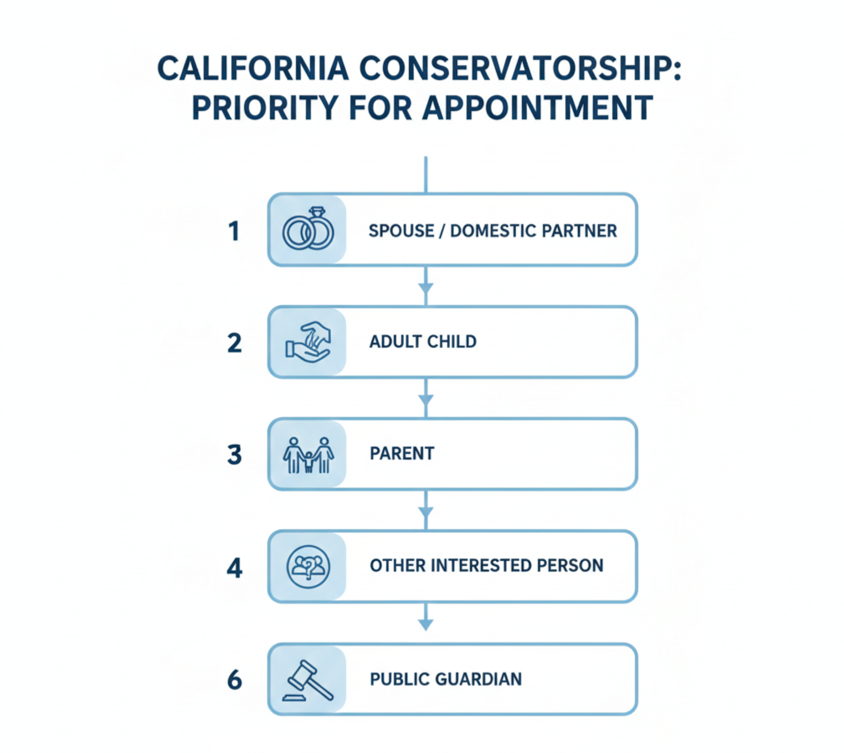
California Probate Code establishes a priority order for appointing conservators: spouse or domestic partner first, followed by adult children, then parents, siblings, any other interested person, and finally the public guardian. However, as the California Courts Self-Help Guide notes, “the court is always going to appoint the person who will serve the conservatee’s interest, regardless of priority for appointment.”
This means siblings often file competing petitions, each seeking control to the exclusion of the other—even when both believe they’re acting in Mom’s best interest.
How California Courts Evaluate Competing Sibling Petitions
When multiple adult children petition for conservatorship of a parent, California probate courts conduct detailed evaluations. According to California Probate Code Section 1812, judges must consider the proposed conservatee’s preferences, if they can be expressed, and the overall best interests of the person needing protection.
The court investigator plays a critical role. Under AB 1194—conservatorship reform legislation signed by Governor Newsom in September 2021 and effective January 1, 2022—investigators have expanded duties including interviewing first-degree family members before the appointment of a conservatorship and reviewing whether less restrictive alternatives were attempted.
In the case of Conservatorship of Ramirez (2001), the California Court of Appeal examined a situation where family members contested professional conservators’ appointments. The court appointed an investigator to interview the proposed conservatee and make determinations about her wishes and capacity. The case demonstrated how courts balance family preferences against the conservatee’s expressed desires and best interests.
Judges evaluate several factors when choosing between competing siblings: geographic proximity to the parent, ability to manage finances responsibly, history of providing care, any conflicts of interest, the parent’s relationship with each child, and whether either sibling has previously exploited or neglected the parent.
Courts may also consider whether siblings can work together. In some cases, judges appoint co-conservators—requiring both siblings to agree on major decisions. However, as the San Diego Superior Court notes in its conservatorship guidelines, this arrangement works only when siblings can cooperate. When they cannot, “Mom’s care and finances will end up in the hands of a third party conservator,” often at significantly higher cost.
The True Cost of Conservatorship Battles
Contested conservatorships impose substantial financial burdens on families—expenses that ultimately come from the parent’s estate.

According to information from California courts and legal practitioners, baseline costs include:
- Filing fee for conservatorship petition: $435-$465
- Court investigator fee: $650-$1,500
- Physician capacity declaration: $200-$500
For uncontested conservatorships, attorney fees typically range from $5,000 to $10,000. However, contested cases escalate dramatically. Legal practitioners estimate contested conservatorships commonly cost $25,000 to $100,000 or more, depending on complexity and duration.
These costs are paid from the conservatee’s estate—meaning Mom pays for both sides of the fight between her children. As CANHR (California Advocates for Nursing Home Reform) explains in their conservatorship FAQ, “Conservatees are expected to pay for both the conservator’s costs and their own costs. This often means that conservatees who fight their conservatorships have to pay twice as much as they might expect.”
In one notable case referenced in California appellate records, a conservator sought approximately $450,000 for services rendered, including $200,000 in attorney’s fees. The court ultimately awarded approximately $25,000—about 10% of the requested amount—after finding the petitioner failed to properly document services.
Beyond direct legal costs, contested conservatorships impose hidden expenses: delay in needed care while litigation proceeds, stress-related health impacts on all parties, permanent damage to sibling relationships, and the potential appointment of an expensive professional conservator when family cannot agree.
California’s 2022 Conservatorship Reforms: What Changed
The high-profile conservatorship of Britney Spears—which ended in November 2021 after 13 years—brought unprecedented attention to California’s conservatorship system. In response, California enacted significant reforms through AB 1194, effective January 1, 2022.
Key changes under AB 1194 include enhanced rights for conservatees to choose their own attorney. The legislation amended Probate Code section 1471 to clarify that court-appointed counsel serves as “a zealous, independent advocate representing the wishes of their client” rather than acting based on the attorney’s perception of the client’s best interests.
The reforms also expanded court investigator duties, requiring more thorough reviews of whether less restrictive alternatives were attempted before conservatorship. Professional fiduciaries now face increased accountability, including mandatory fee disclosures on websites and potential punitive damages up to $10,000 for each act of conservatorship abuse.
Additionally, AB 1663—the Probate Conservatorship Reform and Supported Decision-Making Act signed by Governor Newsom in September 2022—established supported decision-making in California statute as an alternative to conservatorship. This allows adults who need assistance to work with trusted supporters while maintaining their own decision-making authority.
As the California Lawyers Association noted in their 2022 legislation alert, these reforms “emphasize the importance of protecting individual rights and autonomy, ensuring that involuntary treatment is pursued as a last resort.”
Alternatives to Conservatorship Litigation
Before proceeding to court, families should explore less restrictive—and less destructive—alternatives.
Supported Decision-Making Agreements
Under AB 1663, California now formally recognizes supported decision-making as an alternative to conservatorship. According to Disability Rights California, this approach allows individuals to “use trusted friends, family, and professionals to help them understand situations and choices in their life” while retaining their own decision-making authority.
A supported decision-making agreement doesn’t involve the courts. The person needing assistance chooses their supporters, who agree to help them understand, consider, and communicate decisions. This preserves dignity and autonomy while providing necessary assistance.
Durable Powers of Attorney
If a parent executed a durable power of attorney before losing capacity, the designated agent can manage finances and make healthcare decisions without court involvement. However, once incapacity occurs, these documents cannot be created—making advance planning essential.
Living Trusts
When assets are held in a revocable living trust, the successor trustee can manage property upon the parent’s incapacity without a conservatorship of the estate. According to California legal practitioners, if incapacitated parents properly funded their trusts, “a conservatorship of the estate might not be required.”
Mediation
The San Diego Superior Court offers free mediation for guardianship and conservatorship cases through the National Conflict Resolution Center, with suitable cases referred directly by the court. The court notes that “mediation may be particularly effective when family members have a dispute or when emotions are getting in the way of resolution.”
Private probate mediators typically charge $200-$450 per hour, but mediation costs are often far less than litigation—and preserve family relationships that courtroom battles destroy.
Practical Steps for Families Facing Conservatorship Disputes

Step 1: Attempt Family Communication First
Before filing any petition, call a family meeting. Discuss concerns about the parent’s safety, finances, and care needs. Consider involving a neutral third party—a family therapist, mediator, or trusted clergy member—to facilitate discussion.
Step 2: Consult Medical Professionals
Obtain a current assessment of the parent’s capacity from their physician. Understanding the specific areas where the parent needs assistance helps the family determine whether conservatorship is truly necessary or whether less restrictive alternatives would suffice.
Step 3: Review Existing Estate Planning Documents
Check whether the parent previously executed a power of attorney, healthcare directive, or trust. These documents may eliminate the need for conservatorship or indicate the parent’s preferences for who should serve.
Step 4: Consider Supported Decision-Making
Under California’s new framework, evaluate whether the parent could maintain independence with appropriate support. The Arc of California provides resources and sample agreements for implementing supported decision-making arrangements.
Step 5: Consult with a Conservatorship Attorney
If court involvement becomes necessary, work with an attorney experienced in California probate and conservatorship law. An attorney can evaluate whether conservatorship is appropriate, help document why alternatives aren’t sufficient, and navigate the court process efficiently.
Step 6: Focus on the Parent’s Best Interests
Throughout any dispute, keep the focus on what the parent needs—not on sibling grievances. Courts make decisions based on the conservatee’s best interests. Petitions that appear motivated by family conflicts rather than genuine concern for the parent’s welfare face skeptical review.
When a Third-Party Conservator Becomes Necessary
Sometimes sibling conflict is so severe that courts appoint a professional conservator—either from the county public guardian’s office or a licensed private professional fiduciary.
This outcome often represents the worst of all possibilities: neither sibling controls Mom’s care, a stranger makes all decisions, and professional fees—typically $75-$200+ per hour—deplete the estate more rapidly than family conservatorship would.
Under AB 1194’s reforms, professional fiduciaries face enhanced oversight. Licensed fiduciaries must now post fee schedules on their websites or provide them before being retained. The Professional Fiduciaries Bureau can suspend or revoke licenses for fiduciaries who breach duties to clients, and courts must report findings of abuse to the Bureau.
Still, professional conservatorship remains expensive. The best way to avoid this outcome is for family members to reach agreement—or for parents to engage in advance planning while they still have capacity.
The Emotional Reality of Conservatorship Disputes
Beyond the legal and financial dimensions, conservatorship battles exact a profound emotional toll.
Parents often feel caught between warring children, unable to advocate for themselves yet aware of the conflict surrounding them. Some parents respond by disinheriting the child who filed for conservatorship or amending their estate plans to favor one sibling over another—decisions that may later be challenged as the product of undue influence.
Siblings may never fully reconcile. The accusations made in court filings—that a brother mismanaged funds, that a sister neglected care duties—become part of the permanent court record. Long-held resentments surface and calcify.
The stress affects everyone’s health. Caregiving already takes a toll—according to the Alzheimer’s Association’s 2024 Facts and Figures report, family caregivers provided more than 19 billion hours of unpaid care valued at over $413 billion in 2024. Adding litigation stress to caregiving responsibilities creates conditions for burnout, depression, and physical illness.
Conclusion: Prevention Is the True Solution
The conservatorship battle described throughout this article—siblings fighting in court over who controls an aging parent—is almost entirely preventable. The solution lies in advance planning, completed while parents still have the capacity to make and communicate their wishes.
Parents should execute durable powers of attorney for finances and healthcare, create or update their living trust, document their preferences for care and living arrangements, and nominate their preferred conservator in case court involvement ever becomes necessary.
Adult children should have honest conversations with aging parents about their wishes, respect siblings’ different perspectives on care, and consider family meetings facilitated by neutral professionals before conflict escalates.
When conservatorship becomes necessary despite these measures, California law now provides more options than ever—from supported decision-making to enhanced protections for conservatees. The 2022 reforms ensure that even in contested cases, the focus remains on protecting the vulnerable adult’s rights and interests.
For families already facing conflict, the most important step is the next one: consulting with an experienced conservatorship attorney who can evaluate the specific situation and guide the family toward the resolution that best protects Mom.
FAQ Section
How much does a contested conservatorship cost in California?
Contested conservatorships typically cost $25,000-$100,000 or more in attorney fees, paid from the parent’s estate. Filing fees are approximately $435-$465, with additional court investigator fees of $650-$1,500. Costs escalate with complexity and duration.
Can siblings share conservatorship responsibilities in California?
Yes, California courts can appoint co-conservators who must agree on decisions. However, judges typically reserve this arrangement for siblings who demonstrate ability to cooperate. When conflict is severe, courts often appoint a neutral third-party conservator instead.
What is the priority order for appointing a conservator in California?
California Probate Code establishes this order: spouse or domestic partner, adult child, parent, sibling, other interested person, and public guardian. However, courts may deviate from this order when the conservatee’s best interests require a different appointment.
What alternatives exist to conservatorship in California?
California recognizes supported decision-making agreements, durable powers of attorney, living trusts, and representative payee arrangements as less restrictive alternatives. AB 1663 formally established supported decision-making in California law effective 2023.
How long does a conservatorship proceeding take in California?
Temporary conservatorships can be granted within days for emergencies. Permanent conservatorships typically take 60-90 days for uncontested cases. Contested matters may take 6-18 months or longer, depending on the complexity and court calendar.
This article references publicly available information from the California Judicial Council, California Legislature, Alzheimer’s Association, Disability Rights California, and published legal analyses dated 2021-2024. All metrics and citations are from documented sources. Results described are specific to the organizations and cases mentioned and may vary based on individual circumstances, county court procedures, and case complexity. For current information about California conservatorship law, consult official court websites and qualified legal counsel.
