

The IRS announced in October 2025 that the federal estate tax exemption will increase to $15 million per individual starting January 1, 2026, following the passage of the One Big Beautiful Bill Act. This landmark change, combined with California’s updated probate thresholds, makes understanding trustee-beneficiary relationships more important than ever for California families planning their estates.
The short answer to whether a trustee can be a beneficiary in California is yes. California Probate Code explicitly permits this dual-role arrangement, and most revocable living trusts in the state are structured this way. However, specific fiduciary duties and legal boundaries apply that every California resident should understand before establishing or administering a trust in 2026.
What California Law Says About Trustees Who Are Also Beneficiaries
California’s trust laws address the dual role of trustee-beneficiary through several key provisions in the Probate Code. The Superior Court of California, County of Orange, states in its official guidance that “in most cases, the settlor, trustee, and beneficiary are the same person” when creating a living trust. This arrangement represents the standard structure for revocable living trusts used by California families for estate planning.
The California Probate Code establishes three foundational duties that govern this relationship:
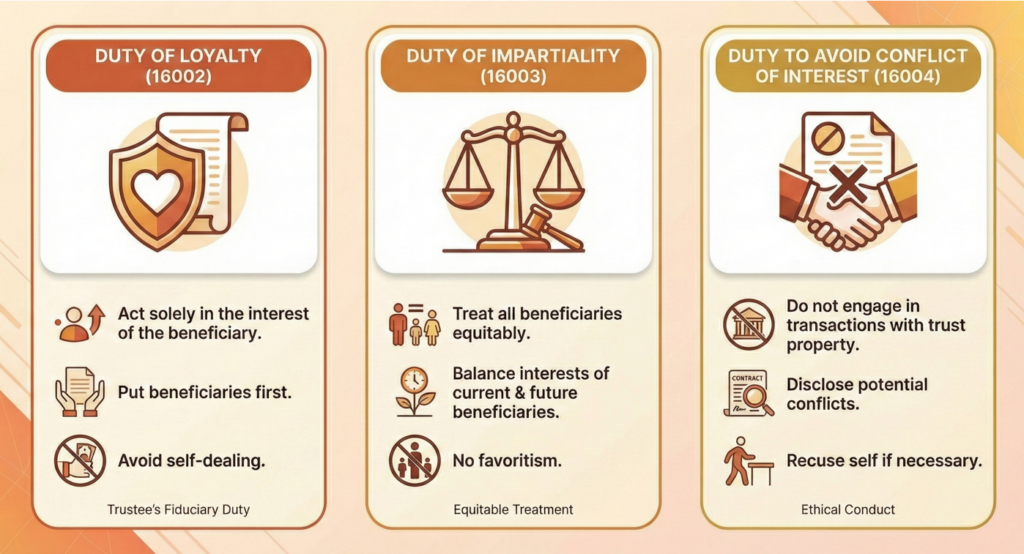
Duty of Loyalty (Probate Code Section 16002): This provision states that “the trustee has a duty to administer the trust solely in the interest of the beneficiaries.” When a trustee is also one of multiple beneficiaries, they cannot prioritize their own interests over those of other beneficiaries.
Duty of Impartiality (Probate Code Section 16003): This section specifies that when a trust has “two or more beneficiaries, the trustee has a duty to deal impartially with them and shall act impartially in investing and managing the trust property.” A trustee-beneficiary must treat all beneficiaries fairly and cannot favor themselves in distributions or trust management decisions.
Duty to Avoid Conflict of Interest (Probate Code Section 16004): Trustees have “a duty not to use or deal with trust property for the trustee’s own profit or for any other purpose unconnected with the trust, nor to take part in any transaction in which the trustee has an interest adverse to the beneficiary.”
The Santa Clara County Superior Court’s self-help probate resources confirm that beneficiaries can petition the court for a trustee’s removal if these duties are violated. Courts can order trustees to compensate the trust for any losses resulting from breaches of fiduciary duty.
The Doctrine of Merger: When the Same Person Cannot Hold Both Roles
One critical limitation exists when the same person serves as both trustee and beneficiary in California. The doctrine of merger can terminate a trust entirely under specific conditions.
According to the Legal Information Institute at Cornell Law School, trust merger refers to “the fusing of legal and equitable title in the event the same person becomes both the sole trustee and the sole beneficiary of a trust.” When this occurs, the trust may be deemed terminated because there is no longer separation between legal ownership and beneficial interest.
The Filippi Law Firm explains that “under the doctrine of merger, if the sole trustee and the sole beneficiary are occupied by the same person, there is no division of property interests between legal and equitable title.” This would make the trust legally invalid because the two types of title have merged.
However, merger does not apply in most common trust situations. As confirmed by legal experts on Avvo, “merger typically does not apply if there are other contingent or secondary beneficiaries, such as charities or other individuals who would inherit the trust assets.” Since virtually all properly drafted trusts name remainder beneficiaries who will receive assets after the primary beneficiary’s death, the merger doctrine rarely causes problems in practice.
2026 Changes Affecting California Trust Planning
Several significant changes taking effect in 2026 impact how California residents should approach trust planning when the trustee will also serve as a beneficiary.
Federal Estate Tax Exemption Increases to $15 Million
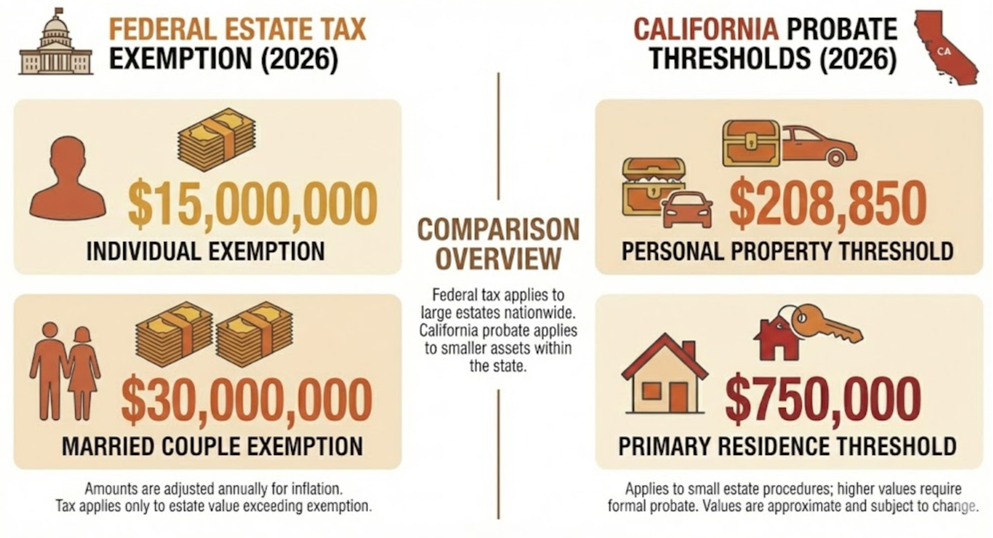
The One Big Beautiful Bill Act, signed into law on July 4, 2025, permanently increased the federal estate and gift tax exemption. According to the IRS announcement from October 2025, “estates of decedents who die during 2026 have a basic exclusion amount of $15,000,000.” This represents an increase from $13,990,000 in 2025.
For married couples, this means $30 million can pass estate-tax-free. The annual gift tax exclusion remains at $19,000 per recipient for 2026, and any gift exceeding this amount reduces the lifetime exemption rather than triggering immediate tax.
Morgan Lewis notes that “this new $15 million gift, estate, and generation-skipping exemption amount is now ‘permanent’ but will continue to be indexed annually to inflation.” This eliminates the uncertainty that existed when the exemption was scheduled to revert to approximately $7 million in 2026 under the prior law.
California Probate Thresholds for 2026
California’s probate thresholds, which determine when simplified transfer procedures can be used instead of formal probate, remain at their April 2025 levels through March 2028:
The Judicial Council of California confirmed these thresholds: $208,850 for the small estate affidavit process for personal property, $750,000 for the Petition to Determine Succession to Primary Residence (for deaths on or after April 1, 2025), and $69,625 for the Affidavit Regarding Real Property of Small Value.
These thresholds will next be adjusted on April 1, 2028, based on Consumer Price Index changes.
Medi-Cal Asset Limits Return January 1, 2026
According to the Tyre Law Group, “starting January 1, 2026, California will reintroduce asset limits for many non-MAGI (long-term care and aged/disabled) programs under Medi-Cal.” The new limits are $130,000 for an individual and $195,000 for a couple.
This change has significant implications for trustees who are also beneficiaries of trusts designed to preserve Medi-Cal eligibility. Transfer-penalty look-back rules will also resume, requiring careful planning for anyone who may need long-term care benefits.
Common Scenarios Where a Trustee Is Also a Beneficiary
Understanding the practical applications of trustee-beneficiary arrangements helps illustrate why this structure is so common in California estate planning.
Scenario 1: The Self-Settled Revocable Living Trust
The most common scenario involves a person who creates a revocable living trust and names themselves as the initial trustee and primary lifetime beneficiary. The Orange County Superior Court confirms this is the standard approach, explaining that the grantor “can be the settlor, the trustee and the beneficiary of the trust” while maintaining “full control over the property.”
In this arrangement, the trust document names successor trustees and remainder beneficiaries who will take over after the grantor’s death or incapacity. This prevents the merger doctrine from applying while allowing the grantor complete control during their lifetime.
Scenario 2: Adult Child Named as Successor Trustee and Beneficiary
Many parents name an adult child as both successor trustee and one of several beneficiaries. Albertson & Davidson LLP notes that “a majority of Trusts have a Trustee who is also a Trust beneficiary” and that when this occurs, “the trustee must exercise caution in everything they do as Trustee to avoid any potential or perceived conflicts of interest.”
The firm warns that “being a Trustee is a thankless job. Trustees take on all the responsibilities and receive few benefits.” When the trustee is also a beneficiary, they must carefully separate their trustee role from their beneficiary role.
Scenario 3: Surviving Spouse as Trustee and Beneficiary
After one spouse passes away, the surviving spouse often serves as trustee of an irrevocable trust while also being a beneficiary. This arrangement requires particular attention to the duty of impartiality if other beneficiaries, such as children from a prior marriage, also have interests in the trust.
Best Practices for Trustees Who Are Also Beneficiaries in 2026
Given the legal requirements and potential for conflict, trustees who are also beneficiaries should follow specific practices to fulfill their fiduciary duties.
Maintain Detailed Records and Provide Transparent Accountings
California Probate Code Section 16060 requires trustees to keep beneficiaries “reasonably informed of the trust and its administration.” Section 16062 mandates that trustees provide accountings to beneficiaries at least annually. Trustees who are also beneficiaries should be especially diligent about documentation to avoid any appearance of impropriety.
Avoid Self-Dealing Transactions
Under Probate Code Section 16004, any transaction where the trustee gains an advantage from a beneficiary “is presumed to be a violation of the trustee’s fiduciary duties.” Trustees should never purchase trust assets for themselves, loan trust funds to themselves, or invest trust assets in their personal business ventures without explicit authorization in the trust document and informed consent from all beneficiaries.
Consider Appointing a Co-Trustee or Independent Advisor
When a trustee is also a beneficiary, naming a co-trustee or an independent advisor can provide valuable oversight and protect against accusations of self-dealing. The trust document can specify that certain decisions, particularly those involving distributions to the trustee-beneficiary, require approval from the co-trustee or advisor.
Review Trust Documents in Light of 2026 Changes
The Law Offices of Daniel A. Hunt recommends that Californians “review and update your estate plan” and “explore trusts and other estate planning tools” given the 2026 changes. Trusts created to use the exemption before the expected 2026 reduction may now contain provisions that no longer serve their original purpose.
Legal Remedies When a Trustee-Beneficiary Breaches Fiduciary Duties
California law provides several remedies for beneficiaries who believe a trustee-beneficiary has violated their duties.
According to Keystone Law Group, “if the trustee fails to fulfill their obligations to the trust beneficiaries, you have the right to utilize the courts to compel the trustee to meet the requirements of their role, according to Probate Code section 16420.”
Available remedies include demanding an accounting under Probate Code Section 16060, petitioning for trustee removal under Section 17200, and seeking a surcharge (damages order) to make the trustee repay mishandled funds. The statute of limitations for breach of fiduciary duty claims is generally four years from when the breach is discovered or reasonably should have been discovered.
The Alameda County Superior Court notes that “the Court can remove a trustee and make the trustee pay the beneficiaries for any loss to the trust” and may “suspend the trustee’s powers while the case is pending if there is reason to believe the beneficiaries’ interests are at risk.”
FAQ SECTION
Can one person legally be both trustee and beneficiary of a California trust?
Yes. California Probate Code permits the same person to serve as both trustee and beneficiary. This is the standard structure for most revocable living trusts, where the grantor serves all three roles during their lifetime.
What is the doctrine of merger and when does it apply?
Merger occurs when the sole trustee and sole beneficiary are the same person, potentially terminating the trust. It does not apply when other contingent or remainder beneficiaries exist, which is true for virtually all properly drafted trusts.
What are the 2026 federal estate tax exemption amounts?
The IRS confirmed the 2026 exemption is $15 million per individual ($30 million for married couples) under the One Big Beautiful Bill Act. The annual gift tax exclusion remains $19,000 per recipient.
Can a trustee-beneficiary be removed for misconduct in California?
Yes. Under Probate Code Section 17200, beneficiaries can petition the court to remove a trustee who breaches fiduciary duties, including self-dealing, failure to account, or favoring themselves over other beneficiaries.
What California probate thresholds apply in 2026?
The small estate affidavit limit is $208,850 for personal property. Primary residences valued at $750,000 or less may qualify for simplified transfer procedures without formal probate for deaths on or after April 1, 2025.
CONCLUSION
California law clearly permits a trustee to also serve as a beneficiary, with the majority of revocable living trusts structured this way. However, this dual role comes with significant fiduciary responsibilities under Probate Code Sections 16002, 16003, and 16004, including duties of loyalty, impartiality, and avoiding conflicts of interest.
The 2026 landscape brings important changes: the federal estate tax exemption increases to $15 million per individual, California probate thresholds remain at their 2025 levels, and Medi-Cal asset limits return on January 1, 2026. These developments make it essential for California residents to review their trust documents and ensure their estate plans reflect current law.
Your next step: If you serve as both trustee and beneficiary of a California trust, or if you’re creating a trust with this structure, consult with a qualified estate planning attorney to ensure your arrangement complies with current law and takes advantage of the 2026 federal exemption increases.
DISCLAIMER
This article references publicly available information from the California Legislative Information database, the Internal Revenue Service, the Judicial Council of California, the Superior Courts of California (Orange, Santa Clara, and Alameda Counties), and legal information from law firms including Albertson & Davidson LLP, Filippi Law Firm, Keystone Law Group, Morgan Lewis, Tyre Law Group, and the Law Offices of Daniel A. Hunt. Information reflects laws and IRS announcements current as of December 2025 through January 2026. All metrics and statutory citations are from documented sources. Results described are general legal information and may vary based on individual circumstances. This article does not constitute legal advice. For current information about California trust law or specific estate planning questions, consult a licensed California attorney.
