

Thomas Tedesco and his late wife Wanda created a trust in 1988 to benefit their three biological daughters. After Wanda’s death in 2002, Thomas married Gloria, who had two daughters of her own, including Debra Wear. By 2013, Thomas had significant cognitive impairment. Gloria began isolating Thomas from his daughters, blocking communications, and removing their photographs from the house. In January 2020, a purported trust amendment was signed — without notice to the conservator, the probate court, or the trustees — disinheriting Thomas’s biological children and grandchildren entirely in favor of Gloria and her daughters. In White v. Wear (2022) 76 Cal.App.5th 24, the Court of Appefal upheld an elder abuse restraining order against Debra and confirmed that procuring a trust amendment through undue influence constitutes financial elder abuse. That case is not unusual. It is one of the most common scenarios in California trust litigation: a surviving parent remarries, the new spouse (or the new spouse’s children) influences the parent to change the trust, and the biological children discover after their parent’s death that they have been disinherited. If this has happened to you, California law provides multiple paths to challenge the amendment. Here is how the law works, when the amendment may be void or voidable, and what you should do now.
How Blended Family Trust Disputes Typically Unfold
The pattern is remarkably consistent across thousands of California trust litigation cases. A married couple creates a joint trust, typically an AB trust, naming their children as the ultimate beneficiaries after both spouses have died. The first spouse dies. The surviving spouse eventually remarries. Over time, the new spouse gains influence over the surviving parent — managing their finances, controlling access to family members, and eventually facilitating changes to the estate plan.
The amendments may be made gradually (small changes over several years) or all at once (a complete restatement shortly before the surviving parent’s death or incapacity). The biological children often do not learn about the changes until they receive the §16061.7 trustee notification after their parent’s death — at which point the 120-day trust contest deadline has already begun running.
In California, stepchildren have no automatic inheritance rights under intestacy laws. Unless they are named in the trust or are legally adopted, they receive nothing. This means the stepparent’s children have everything to gain from a trust amendment that shifts assets away from the biological children — creating powerful incentives for manipulation.
The Critical Question: Can a Surviving Spouse Even Amend the Trust?
The answer depends entirely on how the trust was structured and which assets are at stake. Understanding the trust’s architecture is the first step in any challenge.
Standard AB Trust (Split on First Death)
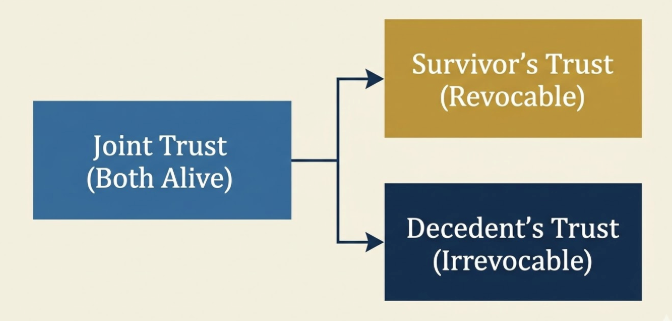
In a standard AB trust — the most common structure for married couples — the trust splits into two subtrusts when the first spouse dies. The Survivor’s Trust (often called the “A Trust”) holds the surviving spouse’s share of the community property and any separate property. This subtrust typically remains revocable — the surviving spouse can amend it freely. The Decedent’s Trust (often called the “B Trust”) holds the deceased spouse’s share of the community property and separate property. By its terms, this subtrust becomes irrevocable upon the first death.
The surviving spouse cannot amend the Decedent’s Trust. The beneficiaries named in that subtrust — typically the biological children — have vested rights that the surviving spouse has no authority to change. Any amendment purporting to alter the distribution of the Decedent’s Trust is void.
This distinction is the foundation of most blended family challenges. If the deceased parent’s share was properly allocated to the irrevocable Decedent’s Trust, the stepparent cannot touch it — period. If the trust was never properly split after the first death, or if the trustee commingled the assets of both subtrusts, that failure itself may constitute a breach of fiduciary duty.
Fully Revocable Trust (No Split on First Death)
Some trusts — particularly simpler trusts drafted for smaller estates — do not split into AB subtrusts. Instead, the entire trust remains revocable until the surviving spouse dies. In this structure, the surviving spouse has the legal authority to amend the trust, including changing beneficiary designations. This is the scenario that creates the most vulnerability for biological children.
However, even when the trust document grants broad amendment powers, the amendment can still be challenged if it was the product of undue influence, fraud, lack of capacity, or financial elder abuse. The surviving spouse’s legal authority to amend does not immunize the amendment from challenge if someone else procured it through manipulation.
Trust With Express Amendment Powers for Survivor
Some trusts include a specific clause granting the surviving spouse the power to amend the testamentary dispositions of the deceased spouse after death. As the Buffington Law Firm noted in their analysis of this scenario, when this provision is “combined with the common scenario whereby the Deceased Spouse’s children are not also the children of the Surviving Spouse, all the pieces are in place for a whopping trust dispute.” The children’s challenge in this case is not that the amendment exceeded the surviving spouse’s authority — but rather that the provision itself was procured through undue influence, or that the surviving spouse’s exercise of the power was the product of manipulation by the new spouse.
Five Legal Claims Available to Disinherited Biological Children
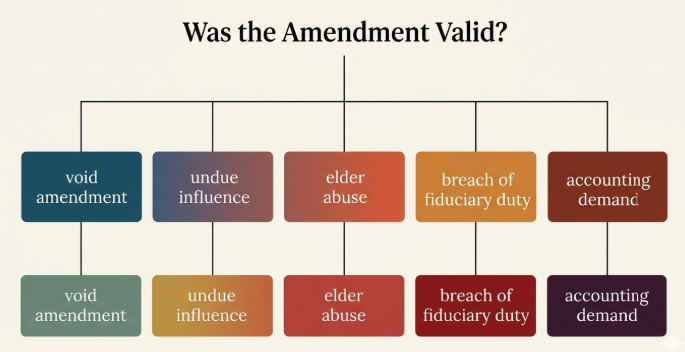
When a stepparent changes a trust to disinherit biological children, the litigation strategy typically involves layering multiple claims. Each claim offers different remedies, different evidentiary standards, and different deadlines. Filing them in combination creates far more leverage than any single claim alone.
1. Void Amendment — The Trust Was Irrevocable
If the trust split into an AB structure upon the first death, any amendment to the Decedent’s Trust is void as a matter of law. The surviving spouse had no authority to change it. This is the strongest possible claim because it does not require proving undue influence, capacity, or bad faith — the amendment simply exceeds the surviving spouse’s powers under the trust instrument. The challenge is establishing that the trust assets were properly allocated between the two subtrusts. If they were not, the failure to allocate may itself be a breach of fiduciary duty by the surviving spouse-trustee.
2. Trust Contest — Undue Influence, Lack of Capacity, or Fraud
Even when the surviving spouse had the authority to amend, the amendment can be challenged as the product of undue influence under Welfare & Institutions Code §15610.70. The four factors courts evaluate are the surviving parent’s vulnerability, the influencer’s apparent authority, the actions taken by the influencer (isolating the parent, controlling information, facilitating document preparation), and the inequity of the result. Under Probate Code §21380, if the new spouse or stepchild drafted or transcribed the amendment, the transfer is presumed to be the product of fraud or undue influence — shifting the burden to the beneficiary of the amendment to prove by clear and convincing evidence that it was legitimate. Trust contests are subject to the 120-day trust contest deadline after receiving the §16061.7 notification.
3. Financial Elder Abuse
In White v. Wear, the Court of Appeal held that procuring a trust amendment through undue influence constitutes financial elder abuse under §15610.30 because it deprives the elder of their property right to dispose of assets as they intended. Filing a financial elder abuse claim alongside the trust contest unlocks mandatory attorney’s fees under §15657.5, Probate Code §859 double damages, and the possibility of elder abuse restraining orders under §15657.03. This claim is not subject to the 120-day trust contest deadline — it operates on its own statute of limitations.
4. Breach of Fiduciary Duty
If the surviving spouse served as trustee while making changes that benefited themselves or their new spouse at the expense of the biological children, that conduct is a breach of fiduciary duty under §16002 (duty of loyalty) and §16004 (duty to avoid self-dealing). Under §16004(c), any transaction between a trustee and beneficiary during the trust’s existence is presumed to be a violation if the trustee obtained an advantage. This four-year statute of limitations claim survives even if the 120-day trust contest window has closed.
5. Petition to Compel Accounting and Trustee Removal
If the surviving spouse-trustee (or their successor) has not provided accountings, the biological children can petition under §17200 to compel a full accounting and simultaneously seek trustee removal under §15642. The accounting often reveals the evidence needed to support the other four claims — unauthorized distributions, commingled assets, undisclosed trustee compensation, and property transfers that benefited the stepparent.
The 2023 Amendment to §15800(b): A New Tool for Biological Children
Effective January 1, 2023, an amendment to Probate Code §15800(b) closed a loophole that had left many biological children in the dark during a parent’s incapacity. Under the prior law, when a surviving parent became incapacitated but the trust was technically still revocable, the successor trustee had no obligation to account to the remainder beneficiaries (typically the biological children) because the trust had not yet become irrevocable.
The 2023 amendment changed this. When the person holding the power to revoke a trust is not legally competent, the successor trustee must now, within 60 days of the incapacity, provide a copy of the trust to all persons who would be entitled to trust income or principal upon the death of the incompetent trustor — and must provide annual accountings and information under §16061 going forward.
For biological children in blended families, this is a powerful new tool. If a parent has become incapacitated and a stepparent (or the stepparent’s child) has taken over as successor trustee, the biological children are now entitled to see the trust document, receive annual accountings, and monitor the trust’s administration — even before the parent dies. This provides an early warning system: if the trust has already been amended to disinherit the biological children, they will learn about it while the parent is still alive, potentially in time to challenge the amendment or seek an elder abuse restraining order.
Emergency Protective Measures: What to Do Before It Is Too Late
If the surviving parent is still alive, emergency court action may be able to stop further manipulation before it becomes permanent.
Under Welfare & Institutions Code §15657.03, a biological child or trustee can petition for an elder abuse restraining order that prevents the alleged abuser from contacting the parent, coming within a specified distance, or — as in White v. Wear — making or facilitating any further changes to the estate plan. This EARO can be granted on an emergency ex parte basis, with a permanent order hearing scheduled 21 to 25 days later.
If the surviving parent is under conservatorship, any trust amendment made without the conservator’s knowledge or court approval is subject to challenge — as it was in White v. Wear, where the 2020 amendment was signed without notice to the conservator, the probate court, or the trustees.
If the surviving parent is not yet under conservatorship but shows signs of cognitive impairment, the biological children can petition for appointment of a conservator of the estate under Probate Code §1800, which would give the court supervisory authority over the parent’s financial affairs — including the trust.
What to Do in the First Week After Discovering the Trust Was Changed
Time is the most important variable. The 120-day trust contest deadline is absolute, and evidence deteriorates every day. Here is a prioritized action plan:
First, note the exact date you received the §16061.7 notification and calculate your 120-day deadline. Mark it prominently. Do not rely on memory.
Second, request a complete copy of the current trust and all amendments immediately. Compare the current version to any prior versions you may have. The differences between versions reveal exactly what was changed, when, and whether the changes benefit the stepparent or their children.
Third, consult a trust litigation attorney within the first week. The Legacy Lawyers offers free consultations and can evaluate your claims — trust contest, financial elder abuse, breach of fiduciary duty, void amendment, accounting demand — simultaneously. The earlier the evaluation begins, the more options remain available.
Fourth, preserve every document you have: prior trust versions, communications with your parent, medical records, photographs, financial statements, and the names of witnesses who had contact with your parent during the period the amendments were made.
Fifth, do not confront the stepparent or trustee. Premature disclosure of your intentions can trigger evidence destruction, accelerated asset distributions, and strategic positioning by the opposing party. Let your attorney control the timing and method of engagement.
Conclusion
When Thomas Tedesco’s stepdaughter Debra Wear helped procure a trust amendment that disinherited his three biological daughters, the Court of Appeal in White v. Wear confirmed that this conduct constituted financial elder abuse — and upheld a restraining order stopping any further manipulation. That outcome reflects a broader truth about blended family trust disputes in California: the law provides robust protections for biological children, but only if those children act within the applicable deadlines.
If a stepparent has changed your parent’s trust to disinherit you, the amendment may be void (if it altered an irrevocable subtrust), voidable (if procured through undue influence, fraud, or lack of capacity), or grounds for a financial elder abuse claim that triggers double damages and mandatory attorney’s fees. But the 120-day trust contest deadline is running from the date you received the trustee notification, and every day that passes without action is a day closer to losing your right to challenge the amendment entirely.
Call The Legacy Lawyers at (800) 840-1998 to schedule a free consultation. Our trust litigation team will review the trust structure, identify which claims apply, and build the multi-layered strategy that gives you the strongest path to protecting your inheritance.
FAQ SECTION
Q: Can a stepparent change my parent’s trust to disinherit me in California?
A: It depends on the trust structure. In a standard AB trust, the deceased parent’s share becomes irrevocable at death — the surviving spouse cannot change it. If the trust remained fully revocable, the surviving spouse may have authority to amend, but the amendment can be challenged if it was the product of undue influence or elder abuse.
Q: What legal claims can I file if a stepparent changed the trust?
A: Potentially five: void amendment (if the trust was irrevocable), trust contest for undue influence or lack of capacity (120-day deadline), financial elder abuse under §15610.30, breach of fiduciary duty by the trustee (4-year SOL), and a petition to compel accounting and remove the trustee under §17200.
Q: Is there a deadline to challenge a stepparent’s trust amendment?
A: For trust contests, you have 120 days from receiving the §16061.7 trustee notification. But breach of fiduciary duty claims have a 4-year deadline, and financial elder abuse claims have their own limitations period. Consulting an attorney within the first week is critical to preserve all available claims.
Q: What happened in White v. Wear?
A: A stepdaughter helped procure a trust amendment disinheriting the biological children of a 94-year-old man with cognitive impairment. The Court of Appeal in White v. Wear (2022) 76 Cal.App.5th 24 upheld an elder abuse restraining order and confirmed that obtaining a trust amendment through undue influence constitutes financial elder abuse.
Q: Can I challenge the trust amendment if my parent is still alive?
A: Yes. If your parent is still alive, you may be able to petition for an elder abuse restraining order to stop further manipulation, seek appointment of a conservator, or invoke the 2023 amendment to §15800(b) to demand accountings from the successor trustee during your parent’s incapacity.
DISCLAIMER
This article references publicly available information including California Probate Code sections 15401, 15642, 15800, 16002, 16004, 16061.7, 17200, 21380, and 859; Welfare & Institutions Code sections 15610.30, 15610.70, and 15657.03; the published Court of Appeal decision in White v. Wear (2022) 76 Cal.App.5th 24; the Lintz v. Lintz (2014) 222 Cal.App.4th 1346 decision on spousal undue influence presumptions; Estate of Powell (2000) 83 Cal.App.4th 1434 on surviving spouse revocation authority; and analysis published by the California Lawyers Association, Buffington Law Firm, Trust on Trial (Downey Brand LLP), Hackard Law, and the California State Bar Trusts & Estates Section, dated 2000–2026. All statutory citations are from the current California Probate Code as published by the California Legislative Information website. Results described are specific to the statutes, cases, and procedures cited and may vary based on jurisdiction, trust terms, and circumstances. For current information about trust litigation services, consult The Legacy Lawyers directly at thelegacylawyers.com.
