

An estimated 6.9 million Americans age 65 and older are living with Alzheimer’s dementia today, according to the Alzheimer’s Association’s 2024 Facts and Figures report. In California alone, 690,000 residents struggle with the disease. For families placing loved ones in memory care facilities, the decision brings relief that professional care will meet their needs—but it also creates vulnerability that unscrupulous individuals increasingly exploit.
Memory care facilities have become fertile ground for trust predators: caregivers, staff members, and even facility-connected professionals who manipulate cognitively impaired residents into changing estate documents. California law provides powerful protections, but families must understand both the threat and their legal remedies to safeguard their loved one’s legacy.
The Perfect Storm: Why Memory Care Residents Face Heightened Risk

Memory care facilities create a unique constellation of risk factors that make residents particularly vulnerable to financial exploitation and undue influence. Understanding these dynamics helps families recognize when intervention becomes necessary.
Cognitive vulnerability creates opportunity. According to the Alzheimer’s Foundation of America, dementia “can make a person especially vulnerable to ‘undue influence’—excessive or inappropriate manipulation where someone uses deception to gain assets without a person’s true consent.” Dr. Sanford Finkel, a geriatric psychiatrist with 34 years’ experience in will contests, notes that “relatives, friends, professionals, and caregivers are all in a position to exercise undue influence” over dementia patients.
Isolation from family oversight increases danger. The Evans Law Firm observes that nursing home residents are “particularly susceptible because they typically are the most dependent on others for their care” and “are, by definition, isolated from their friends, family, and community.” This isolation allows manipulation to occur without detection.
Staff access creates pathways to exploitation. Nursing home staff have “virtually unrestricted access to their patients and their patients’ living quarters, giving them easy access to their belongings,” according to California elder abuse attorneys. This access extends to personal documents, financial records, and opportunities to build trust relationships that can later be exploited.
Communication barriers prevent reporting. The Evans Law Firm notes that “many dementia patients suffer memory loss, which may reduce their ability to remember a specific instance of theft or other financial elder abuse. And even if they remember the incident, they often have difficulty putting their thoughts into words.”
The statistics confirm these vulnerabilities translate to actual harm. According to the National Council on Aging, nearly one in two people with dementia experience some form of abuse. The World Health Organization reports that two in three nursing home staff members admitted to committing abuse in the past year. In California specifically, the Attorney General’s office found that 13% of all complaints to the Long-Term Care Ombudsman involved abuse, gross neglect, or exploitation—more than twice the national rate of 5%.
How Trust Predators Operate in Memory Care Settings
Trust predators in memory care facilities employ sophisticated strategies that exploit the unique dynamics of institutional care. Recognizing these patterns helps families identify problems before irreversible harm occurs.
The Relationship Builder
This predator invests months cultivating a special relationship with the resident. They become the person who “really understands” the resident, who provides extra attention, who seems genuinely devoted. Families may initially feel grateful for this apparent dedication.
The manipulation begins subtly. The caregiver starts making negative comments about family members: “Your daughter never visits anymore.” “Your son only cares about your money.” This “relationship poisoning” gradually isolates the resident from their actual support network while strengthening dependency on the caregiver.
According to Hackard Law, “a common act of exploitation is a family member or caregiver prompting the elder to change their trust. The elder is lost in a demented world. The change may be an easy sell for someone who has lost their life bearings.”
The Document Facilitator
Some predators work in conjunction with—or pose as—professionals who can execute estate document changes. They may bring in a notary, connect the resident with an unknown attorney, or produce documents for signature during lucid-seeming moments.
California attorneys have documented cases where “the initial lawyer who drafted the [original estate plan] refused to draft the new Trust because she suspected that [someone] was unduly influencing” the elder—and the influencer then found an unqualified attorney willing to prepare suspicious documents.
The Financial Controller
This predator gradually assumes control over the resident’s financial life. They may start by “helping” with small tasks, then expand to managing all finances, intercepting mail, and controlling access to accounts.
Warning signs include what San Francisco elder abuse attorney Ingrid Evans describes: “People are pretty systematic and have a set amount they withdraw—say, $200 a week. If that suddenly changes to $1,000 a week, there’s something going on.”
California’s Powerful Legal Protections: Probate Code Section 21380
California provides some of the nation’s strongest protections against caregiver exploitation through Probate Code Section 21380. This statute creates a presumption of fraud or undue influence when certain individuals receive inheritance benefits—shifting the burden of proof to the suspected wrongdoer.
Who Triggers the Presumption
California Probate Code Section 21380 applies to transfers made to:
Care custodians of dependent adults. If someone provided care services to your loved one and appears in their estate documents, California law presumes that inheritance resulted from fraud or undue influence. This applies when “property was transferred to them during the administration of their care or within 90 days before or after that period of care.”
Document drafters and transcribers. Anyone who “drafted the instrument, transcribed it, or was in a ‘fiduciary relationship’ with the decedent when the instrument was transcribed” triggers the presumption.
New romantic relationships. Someone who “recently entered into a domestic partnership, marriage, or cohabitation with the decedent within 90 days of the execution of the instrument” is also covered.
What the Presumption Means Practically
According to Gokal Law Group, this presumption “makes it significantly easier for beneficiaries like yourself to work with a California trust litigation lawyer, file a lawsuit, invalidate a trust or will, and protect your inheritance.”
The burden of proof shifts to the caregiver, who must demonstrate by “clear and convincing evidence” that no manipulation occurred. As the Buffington Law Firm explains, this is “a higher standard than simple ‘preponderance of the evidence'” and represents a significant advantage for families challenging suspicious transfers.
If the caregiver cannot meet this burden, California Probate Code Section 21380(d) provides that “the beneficiary shall bear all costs of the proceeding, including reasonable attorney’s fees.”
Exceptions to Know
The presumption does not apply when the caregiver:
- Was related by blood or marriage to the resident
- Did not receive payment for caregiving services
- Was personally acquainted with the resident at least 90 days before the documents were created
- Received a gift valued at $5,000 or less
Additionally, California allows the presumption to be overcome if an independent attorney reviews the transfer, counsels the transferor out of the presence of the beneficiary, and provides a Certificate of Independent Review confirming the transfer wasn’t the product of fraud or undue influence.
The Scale of the Problem: Statistics That Demand Action
The numbers reveal why vigilance matters for every family with a loved one in memory care:
Financial losses are staggering. The National Council on Aging reports elder financial abuse causes $28.3 billion in annual losses nationally. According to the 2024 FinCEN analysis, adult children are the most frequent perpetrators in elder theft cases—but professional caregivers represent a growing threat.
Underreporting masks the true scope. For every case of elder financial abuse reported, 43 go unreported according to the National Adult Protective Services Association. The California Association of Area Agencies on Aging confirms this ratio: “For financial abuse, only one in 44 cases is known.”
Dementia residents face disproportionate risk. The National Center on Elder Abuse reports that as many as one in two people with dementia experience abuse. More than half of nursing home residents have dementia, making memory care facilities particularly high-risk environments.
California sees elevated abuse rates. The California Attorney General’s office notes that the state’s complaints about abuse, gross neglect, or exploitation run at more than twice the national average. With California’s elderly population projected to double by 2030, this problem will only intensify.
Nursing home violations are widespread. In 2023, U.S. nursing homes received 94,499 health citations according to the Centers for Medicare and Medicaid Services. Of these, 8.1% (7,654 citations) related specifically to abuse, neglect, or exploitation.
Warning Signs: When to Take Action
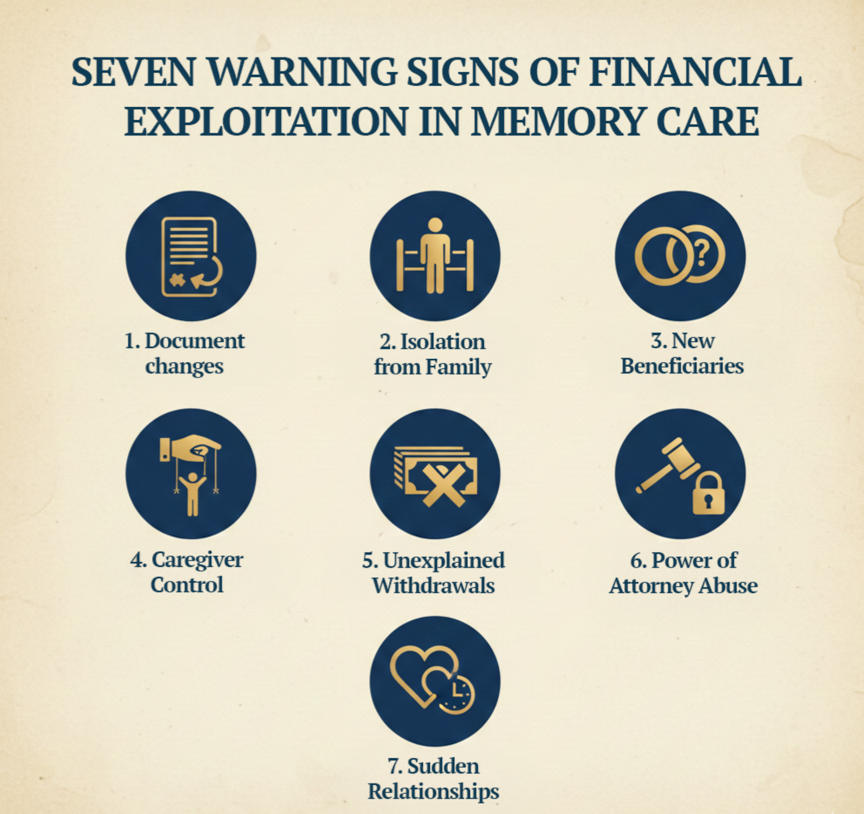
Families should monitor for these indicators that a memory care resident may be experiencing financial exploitation or undue influence:
Document changes without family knowledge. Learning that your loved one’s estate plan, power of attorney, or beneficiary designations have been modified—especially if you weren’t informed—warrants immediate investigation. As trust litigation attorneys note, changes made “shortly before the decedent’s passing or when they were in a vulnerable state” constitute strong evidence of potential inheritance theft.
New beneficiaries appearing. The Alzheimer’s Foundation identifies a key red flag: “A ‘new’ beneficiary appears in the will, someone in a position of power that the person is/was dependent upon (financially or for care, such as access to medications, doctor’s appointments, food, or activities of daily living).”
Restricted family access. If a caregiver or staff member controls when and how you can communicate with your loved one, this isolation tactic may signal manipulation. According to elder abuse experts, “isolating the elderly person from other family members” is a primary method influencers use to gain control.
Unexplained financial activity. Watch for unusual withdrawals, new joint accounts, changed beneficiary designations on life insurance or retirement accounts, or transfers of property. Attorney Ingrid Evans advises: “Ask if they have an estate plan and, if they do, ask for a copy of it. Ask if they’ve changed it or anyone has pressured them to change it.”
Caregiver dependency. If your loved one expresses that they “owe” a caregiver something, seems afraid of displeasing specific staff members, or makes comments suggesting coerced generosity, investigate immediately.
Resistance to transparency. When facility administrators, staff, or anyone involved with your loved one’s care resists providing information about their finances, legal matters, or wellbeing, treat this as a serious warning sign.
Protective Strategies for Families
Taking proactive steps can significantly reduce the risk of exploitation while your loved one remains in memory care:
Maintain regular presence. Frequent, unpredictable visits make it harder for predators to operate. Vary your visiting times and days to observe different shifts and situations.
Never grant power of attorney to facility staff. California elder abuse attorneys unanimously advise: “Never, ever grant a power of attorney to a caregiver or nursing home staff member.” This applies regardless of how trustworthy they seem.
Secure estate documents before placement. Ideally, complete all estate planning before cognitive decline advances. If documents already exist, ensure multiple trusted family members have copies and know your loved one’s true wishes.
Monitor financial accounts actively. Set up alerts on bank accounts and credit cards. Review statements monthly. Document any concerns immediately.
Document concerning behavior. Keep written records of troubling conversations, changes in your loved one’s accessibility, or unusual requests. This documentation becomes critical evidence if litigation becomes necessary.
Know your deadlines. Under California law, beneficiaries typically have 120 days from receiving notice of a trust to contest its validity. Waiting too long can permanently bar your claims.
When Legal Intervention Becomes Necessary
Not every concerning situation rises to actionable legal claims. However, certain circumstances warrant immediate consultation with a California trust litigation attorney:
- Discovery that estate documents were changed during or after memory care placement
- Learning that a caregiver, staff member, or facility-connected individual has been named as a beneficiary
- Evidence that your loved one was in a “vulnerable state” when signing new documents
- Significant assets transferred outside the estate plan to non-family members
- Documents prepared by an unfamiliar attorney or notarized under suspicious circumstances
California provides specific remedies. You can file a petition in probate court challenging trust or will validity. Courts can freeze assets during investigation, compel accountings from trustees, and award attorneys’ fees to successful challengers when undue influence is proven.
The California Supreme Court established important precedent when it “ruled in 2006 that a will was invalid because a caregiver had the majority of a $450,000 estate transferred to her by way of undue influence.” This case demonstrated that courts take caregiver exploitation seriously and will invalidate improper transfers.
The Path Forward: Protecting Your Family’s Legacy
The intersection of California’s aging population, the dementia epidemic, and the structure of institutional care creates unprecedented risk for estate exploitation. The Alzheimer’s Association projects that Americans living with Alzheimer’s could reach 13.8 million by 2060, with California bearing a disproportionate share of this burden.
But California law provides powerful tools. Probate Code Section 21380’s presumption of undue influence shifts the burden to suspected wrongdoers. The state’s elder abuse reporting infrastructure enables investigation and prosecution. And experienced trust litigation attorneys understand how to challenge improper transfers and protect legitimate inheritances.
If you have a loved one in memory care, don’t wait for problems to emerge. Review existing estate documents. Establish monitoring systems. Communicate your concerns with facility administrators in writing. And if you observe warning signs of exploitation, consult immediately with a California estate litigation attorney who understands both the emotional and legal dimensions of these cases.
Your loved one deserves protection. Their legacy deserves preservation. And California law stands ready to help—if you act in time.
FAQ SECTION
Can a memory care facility caregiver legally inherit from a resident in California?
While technically possible, California Probate Code Section 21380 creates a presumption that any inheritance to a caregiver resulted from fraud or undue influence. The caregiver must prove by “clear and convincing evidence” that no manipulation occurred—a difficult burden that often results in invalidated transfers.
How long do I have to contest a trust if I suspect undue influence?
California law typically provides 120 days from receiving the statutory notice of trust to file a contest. If the trustee fails to provide a copy of the trust document upon request, an additional 60 days applies. Missing these deadlines can permanently bar your claim.
What if my loved one with dementia signed new estate documents—are they automatically invalid?
Not automatically. Having dementia doesn’t eliminate testamentary capacity. However, if documents were created when your loved one couldn’t understand their assets, beneficiaries, and the consequences of their decisions, courts may find they lacked capacity. Combined with evidence of undue influence, such documents can be invalidated.
What are the most common warning signs of financial exploitation in memory care facilities?
Key indicators include: unexplained changes to estate documents, new beneficiaries appearing (especially caregivers), restricted family access, unusual financial account activity, caregiver dependency, and resistance from staff to providing information about the resident’s affairs.
How much does elder financial abuse cost victims annually?
The National Council on Aging estimates elder financial abuse causes $28.3 billion in annual losses nationally. For individual victims, losses can range from thousands to entire life savings. In California, the Attorney General’s office reports abuse complaint rates more than double the national average.
DISCLAIMER
This article references publicly available information from the Alzheimer’s Association, National Council on Aging, California Attorney General’s Office, Centers for Medicare and Medicaid Services, FinCEN, and various California legal resources, including official documentation, press releases, and published studies dated 2022-2025. All metrics and quotes are from documented sources. Information presented is specific to California law and may vary based on individual circumstances, case complexity, and judicial discretion. California elder law changes regularly; AB 1417 altered mandatory reporting obligations effective January 1, 2024. This article is for informational purposes only and does not constitute legal advice or create an attorney-client relationship. For current information about California estate law, memory care protections, and your specific situation, consult directly with The Legacy Lawyers.
