

When Priscilla Presley, at age 79, filed a lawsuit in 2024 alleging she had been defrauded of over $1 million by people she once trusted—including claims that she was coerced into signing documents handing over 80% of her earnings—it shocked fans worldwide. But for California trust litigation attorneys, her case represented a tragically familiar pattern: wealthy, aging entertainment figures falling prey to those positioned closest to them.
According to a 2024 AARP report, elder financial abuse victims lose an estimated $28.3 billion annually in the United States. The Consumer Financial Protection Bureau found that when seniors know their abuser—a family member, friend, or caregiver—average losses reach $50,000, nearly triple the $17,000 average when the perpetrator is a stranger. For high-net-worth individuals in the entertainment industry, losses routinely reach into the millions.
This guide examines how caregiver exploitation schemes operate, what California law provides to protect elders and their families, and how to recognize warning signs before it’s too late.
The Anatomy of Caregiver Financial Abuse: Lessons from Hollywood

Elder financial abuse occurs when someone takes or misuses an older person’s money or property for their own benefit. California Welfare and Institutions Code Section 15610.30 defines it as the wrongful taking, hiding, misusing, or retaining of an elder’s property—including through undue influence.
What makes entertainment industry elders particularly vulnerable is a toxic combination of factors: substantial wealth, advancing age, cognitive decline, and isolation from family due to demanding careers that may have strained relationships decades earlier.
The Mickey Rooney Case: A Star Reduced to Canned Food
Perhaps no celebrity case better illustrates the devastating impact of caregiver financial abuse than that of Mickey Rooney. The legendary actor, whose career spanned nine decades, spent his final years living in fear and poverty—despite having earned millions throughout his lifetime.
According to court filings and Rooney’s own testimony before the U.S. Senate Special Aging Committee in 2011, Rooney described being “scared, disappointed, angry…overwhelmed” when he realized the true nature of his situation. The actor alleged that his stepson and the stepson’s wife, who served as his caregivers, had taken control of his finances while keeping him isolated and dependent.
Court documents revealed classic patterns of exploitation: Rooney was allegedly not permitted to go to the grocery store or even order his own groceries for delivery. He reportedly ate canned food while his caregivers vacationed. His complaint alleged he had been reduced to complete dependence on people who controlled every aspect of his daily life.
Attorney Vivian Lee Thoreen of Holland & Knight, who represented Rooney and his estate, later established the Mickey Rooney Elder Abuse Pro Bono Project to help protect seniors who cannot afford legal services. As she has noted in interviews, Rooney’s case exhibited the classic red flags of elder abuse: complete dependence upon the perpetrator, isolation from others, and a shortage of basic necessities despite adequate income.
When Rooney died in 2014, his estate was valued at approximately $18,000—a stunning fall for an actor who had once been one of Hollywood’s highest-paid stars.
Stan Lee: The Marvel Creator’s Final Years
Comic book legend Stan Lee faced similar exploitation allegations in his final years. After his wife’s death in July 2017, Lee appointed Jerry Olivarez, a publicist, as his agent under a power of attorney. According to the complaint filed by Lee’s estate after his death in November 2018, Olivarez allegedly engaged in a pattern of misconduct.
The estate’s lawsuit alleged that Olivarez dismissed Stan Lee’s longtime lawyer and hired his own without disclosing conflicts of interest, terminated the creator’s banker and transferred approximately $4.6 million out of Lee’s accounts, convinced Lee to loan him $300,000, and purchased an expensive condominium using Lee’s money.
The suit included causes of action for financial abuse of an elder, fraud, and misappropriation of name and likeness. A settlement was eventually reached for an undisclosed amount, allowing the probate case to proceed.
As one attorney noted when discussing Lee’s situation, the case raised numerous red flags: an elderly man who had recently lost his spouse, firing of long-time advisors, a single person managing all financial affairs, estrangement from his nearest living relative, and already-documented losses from people in his inner circle.
Leonard Cohen: The $5 Million Manager Theft
In 2005, singer-songwriter Leonard Cohen discovered that his manager had stolen over $5 million from him. The 71-year-old artist had trusted his manager with his financial affairs, only to learn that his retirement savings had been systematically looted.
Courts ordered the manager to repay nearly $10 million and serve 18 months in jail. Cohen was forced out of retirement in his seventies to tour and rebuild his wealth—a situation that would have destroyed a less resilient or less famous individual.
California’s Legal Arsenal Against Caregiver Exploitation
California has developed one of the nation’s most robust legal frameworks for combating elder financial abuse. Understanding these protections is essential for families seeking to protect vulnerable loved ones or recover assets after exploitation has occurred.
Probate Code Section 21380: The Caregiver Presumption
California Probate Code Section 21380 creates a powerful presumption of fraud or undue influence when certain individuals receive gifts through wills or trusts. Under this statute, a transfer to any of the following persons is presumed to be the product of fraud or undue influence:
Anyone who drafted or transcribed the instrument or held a fiduciary relationship with the decedent when the document was created; a care custodian of a dependent adult who received a transfer during the period of care or within 90 days before or after; or someone who recently entered into a relationship, marriage, or cohabitation with the decedent within 90 days of executing the document.
This presumption shifts the burden of proof to the caregiver. Rather than the family having to prove exploitation occurred, the caregiver must demonstrate by clear and convincing evidence that they did not use fraud or undue influence—a significantly more difficult standard to meet.
As one California appellate court explained in a 2025 ruling involving a caregiver who manipulated an elderly man into naming her as sole trustee and beneficiary: the caregiver had to prove otherwise by clear and convincing evidence under Probate Code Section 21380, and the court scrutinized the amendments as presumptively fraudulent.
Probate Code Section 859: Double Damages and Attorney’s Fees
California Probate Code Section 859 provides enhanced remedies when property has been wrongfully taken from an elder, trust, or estate. The statute states that if a court finds a person has in bad faith wrongfully taken, concealed, or disposed of property belonging to an elder, dependent adult, trust, or estate—or has done so through undue influence or elder financial abuse—that person shall be liable for twice the value of the property recovered.
Additionally, the court may award reasonable attorney’s fees and costs to the prevailing party. This provision is critical because it allows families to pursue recovery without depleting the estate through litigation expenses.
For example, in the 2024 case Asaro v. Maniscalco, a California appellate court affirmed an award requiring a trustee who committed financial elder abuse to pay the amount of trust property taken plus twice the value of the property, along with the beneficiary’s attorney’s fees.
The Undue Influence Framework
California courts have developed a three-factor test for establishing a presumption of undue influence, even outside the specific caregiver statute. When all three elements are present, the burden shifts to the alleged influencer to prove the transaction was legitimate:
A confidential relationship between the influencer and the elder—such as caregiver, financial advisor, or close companion; active participation by the influencer in creating or executing documents—like selecting the attorney, giving instructions, or attending the signing; and an undue benefit to the influencer—receiving a disproportionate share inconsistent with prior plans or normal expectations.
When these elements combine, California courts presume undue influence occurred, forcing the beneficiary to prove otherwise.
Warning Signs: How Exploitation Unfolds
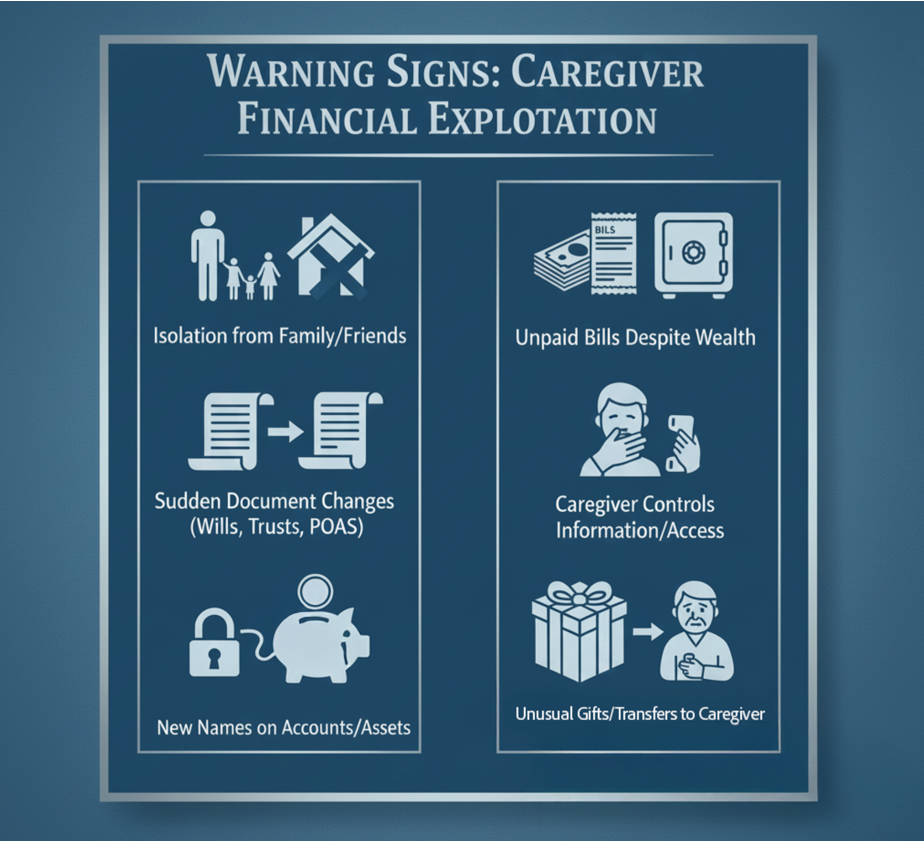
Financial exploitation rarely happens overnight. Instead, it typically follows a predictable pattern that families can learn to recognize.
Phase One: Building Trust and Dependence
The exploitation often begins with exceptional caregiving. The caregiver becomes indispensable, handling everything from medical appointments to daily meals. The elder grows to trust and depend on this person completely.
During this phase, the caregiver may begin subtly positioning themselves as more trustworthy than family members. Comments like “Your children never visit” or “I’m the only one who really cares about you” plant seeds of isolation.
Phase Two: Isolation
The California Department of Aging identifies isolation as a primary warning sign. The elder becomes increasingly cut off from family, friends, and longtime advisors. Phone calls may be screened. Visits may be discouraged or prevented. The caregiver becomes the gatekeeper for all contact.
In Mickey Rooney’s case, court documents alleged that anxiety would visibly overwhelm him whenever his caregiver entered the room. He reportedly was not permitted to leave the house or interact with others without supervision.
Phase Three: Document Manipulation
With the elder isolated and dependent, the caregiver begins manipulating legal and financial documents. This may include becoming a signatory on bank accounts, obtaining power of attorney, revising trust documents, or influencing changes to the will.
According to the U.S. Department of Justice Elder Justice Initiative, warning signs at this stage include sudden changes in banking practices, unauthorized withdrawals using the elder’s ATM card, abrupt changes in wills or financial documents, unexplained disappearance of funds, and the sudden appearance of a previously uninvolved person claiming rights to the elder’s property.
Phase Four: Asset Extraction
With legal authority secured, the caregiver begins transferring assets. This may happen gradually—small withdrawals that avoid detection—or rapidly once the caregiver senses discovery is imminent.
The Consumer Financial Protection Bureau notes that financial abuse often goes hand-in-hand with other forms of elder abuse, creating a complex situation that requires both immediate intervention and long-term legal remedies.
Proper Planning: The Jay Leno Example
Not all conservatorship cases involve exploitation. Some represent thoughtful planning by devoted family members facing a loved one’s cognitive decline.
In January 2024, comedian Jay Leno filed for conservatorship of his wife Mavis’s estate after her diagnosis of advanced dementia. According to court documents, Mavis had been “progressively losing capacity and orientation to space and time for several years.”
Leno’s petition sought authority to implement an estate plan that he believed his wife would have executed if she still had capacity. His attorney explained that while the couple had a living trust and will created before the dementia diagnosis, Leno needed court authority to restructure their affairs because his wife could no longer legally consent to changes.
In April 2024, the court granted the conservatorship. The presiding judge praised Leno’s caregiving, stating that Mavis was “in very good care” and that “everything you’re doing is right.”
The Leno case illustrates several important lessons. First, proper estate planning before incapacity prevents exploitation opportunities. Second, conservatorship, when properly used, protects rather than exploits. Third, transparent court oversight provides accountability. And fourth, advance documentation of wishes prevents disputes.
As Leno has since shared publicly, he views his caregiving role as the fulfillment of his marriage vows. His approach demonstrates how proper legal planning and genuine devotion can protect vulnerable individuals from exploitation.
What Families Can Do: Protection and Recovery

Preventive Measures
The most effective protection against caregiver financial abuse is advance planning. Before cognitive decline begins, elderly parents should establish revocable living trusts with multiple co-trustees or oversight provisions, execute durable powers of attorney with safeguards and reporting requirements, create healthcare directives specifying trusted decision-makers, implement financial monitoring systems with family access, and nominate their preferred conservator in case court intervention becomes necessary.
California’s supported decision-making framework, established by AB 1663 in 2022, provides an alternative to conservatorship that allows elders to maintain autonomy while receiving assistance from trusted supporters.
Early Intervention
When warning signs appear, families should act quickly. Document all suspicious activities with dates and details. Request copies of financial statements and legal documents. Contact Adult Protective Services, which investigates elder abuse regardless of income level—California’s reporting hotline is 833-401-0832. Consult with an attorney experienced in elder abuse and trust litigation. Consider whether a conservatorship petition is necessary to protect the elder.
California law requires all financial institution employees to report suspected elder financial abuse. If you suspect a bank or financial advisor is facilitating exploitation, report concerns to the California Department of Financial Protection and Innovation.
Recovery Through Litigation
When prevention fails, California law provides powerful recovery tools. Trust contest litigation can invalidate documents obtained through undue influence or fraud, the caregiver presumption in Probate Code 21380 shifts the burden to the exploiter, Probate Code 859 allows recovery of double damages plus attorney’s fees, and Welfare and Institutions Code Section 15657.5 provides additional remedies for elder abuse.
Successful litigation requires building a comprehensive case that documents the confidential relationship, the caregiver’s active participation in document changes, the undue benefit received, and the elder’s vulnerability and the caregiver’s exploitation of it.
The Entertainment Industry Context
High-net-worth entertainment industry families face unique challenges. Careers built on public performance may have strained family relationships. Enormous wealth accumulated over decades creates attractive targets. Fame can attract predatory individuals seeking proximity to celebrities. Industry norms of having “people” handle everything create vulnerabilities.
According to the California Board of Accountancy, California has more than 4.2 million people aged 65 and older—the highest elderly population of any state—representing 11% of the state’s population. That number is expected to grow to 20% within the next two decades, meaning elder financial abuse will only increase in prevalence.
California’s Association of Area Agencies on Aging estimates approximately 202,549 cases of reported elder and dependent adult abuse occur annually in California. More troubling, the organization notes that for every case known to agencies, 24 go unreported. For financial abuse specifically, only one in 44 cases is ever reported.
Conclusion: Vigilance and Action
The pattern that destroyed Mickey Rooney’s final years, drained Leonard Cohen’s retirement, and allegedly exploited Priscilla Presley follows a recognizable script: an elder with substantial wealth becomes dependent on a caregiver who gradually isolates them, manipulates legal documents, and extracts assets while the family watches helplessly or remains unaware.
California law provides robust protections—but they work only when families recognize warning signs early, document suspicious behavior, and act decisively. The caregiver presumption in Probate Code 21380 and the double damages provision in Probate Code 859 give families powerful tools, but these remedies require legal action to enforce.
For families with elderly loved ones in the entertainment industry—or any high-net-worth environment—the most important step is proactive planning. Establish proper estate documents with built-in safeguards. Maintain regular communication with elderly parents. Know who provides care and monitor those relationships.
When exploitation does occur, experienced trust litigation attorneys can pursue recovery through the courts. The law is designed to punish bad actors and restore stolen assets. But prevention remains far better than cure.
If you recognize the warning signs described in this article—isolation, document changes, new people controlling access and finances—the time to act is now.
FAQ Section
What is the “caregiver presumption” under California law?
California Probate Code Section 21380 presumes that any gift to a caregiver in a will or trust is the product of fraud or undue influence. The caregiver must prove by clear and convincing evidence that no manipulation occurred—a very difficult burden to meet.
Can I recover double damages for elder financial abuse in California?
Yes. Probate Code Section 859 provides that if someone wrongfully takes an elder’s property through bad faith or undue influence, they may be liable for twice the value of the recovered property, plus attorney’s fees and costs at the court’s discretion.
What are the warning signs of caregiver financial exploitation?
Key warning signs include isolation from family and friends, sudden changes to estate documents, unexplained financial transactions, a caregiver who controls access to the elder, unpaid bills despite adequate resources, and the elder appearing anxious around the caregiver.
How quickly must I act to contest a trust in California?
Under Probate Code Section 16061.7, beneficiaries have 120 days after receiving the Notice of Trust Administration to contest a trust. However, evidence may disappear and assets may be depleted during delay—so earlier action is always preferable.
Can Adult Protective Services help with financial exploitation?
Yes. California Adult Protective Services investigates elder abuse regardless of income. Call 833-401-0832 and enter your zip code to connect with your county’s APS office, available 24/7. Financial institutions are also mandated reporters of suspected elder financial abuse.
This article references publicly available information from court filings, the U.S. Department of Justice Elder Justice Initiative, the California Legislature, AARP, the Consumer Financial Protection Bureau, and published news reports dated 2019-2024. All case references are from documented legal proceedings or public statements. Results described are specific to the cases mentioned and may vary based on individual circumstances. For current information about California elder abuse law, consult official sources and qualified legal counsel.