

In Meiri v. Shamtoubi (2022) 81 Cal.App.5th 606, a trust beneficiary filed a contest alleging undue influence and fraud — 230 days after receiving the statutory notification. She was 110 days late. The Second District Court of Appeal ruled that her untimely filing was a “direct contest without probable cause,” triggered the trust’s no-contest clause, and resulted in her complete disinheritance. She lost everything — not because her claims lacked merit, but because she missed a deadline. That case illustrates the two realities of contesting a will in California: the law provides powerful grounds to challenge an invalid document, but the procedural rules are unforgiving. If you believe a loved one’s will does not reflect their true wishes, here is exactly what the law allows, what it requires, and how experienced trust litigation attorneys navigate the process from filing to trial.

The Seven Legal Grounds to Contest a Will in California
California Probate Code §8252 enumerates the specific grounds on which a will can be contested. You cannot challenge a will simply because you disagree with it or feel the distribution is unfair. The law requires proof that the document itself is legally defective.
1. Lack of Testamentary Capacity
Under Probate Code §6100.5, a person lacks testamentary capacity if, at the time they signed the will, they could not understand the nature of the testamentary act, could not understand and recollect the nature and situation of their property, or could not remember and understand their relations to their living descendants, spouse, parents, and those whose interests are affected by the will.
The standard is intentionally low. As the court noted in In re Estate of Perkins (1925) 195 Cal. 699, the ability to transact ordinary business is not the legal standard for testamentary capacity. A person with a dementia diagnosis can still have periods of lucidity sufficient to execute a valid will. The question is always what was their mental state at the specific moment they signed the document — not generally, but precisely then.
Evidence that supports a capacity challenge includes medical records showing cognitive decline around the date of execution, testimony from physicians or neuropsychologists who evaluated the testator, statements from caregivers or family members who observed confusion or disorientation, and records of hospitalizations or medication changes near the signing date.
2. Undue Influence
Undue influence occurs when another person exerts “excessive persuasion” that overcomes the testator’s free will, as defined under Welfare & Institutions Code §15610.70. The four factors courts evaluate are the testator’s vulnerability (age, illness, cognitive impairment, isolation, dependency), the influencer’s apparent authority (status as a family member, caregiver, fiduciary, or legal professional), the actions taken by the influencer (controlling access to the testator, isolating them from family, orchestrating changes to estate documents), and the equity of the result (whether the new will deviates dramatically from prior versions or from what the testator had expressed to others).
A common law presumption of undue influence arises when the challenger shows that the alleged influencer had a confidential relationship with the testator, actively participated in procuring the will’s preparation or execution, and would benefit unduly from the instrument. Once this presumption is established, the burden shifts to the proponent to prove the will was not the product of undue influence.
Additionally, Probate Code §21380 creates a statutory presumption that a donative transfer is the product of fraud or undue influence when the recipient is the person who drafted the instrument, a person who transcribed it while in a fiduciary relationship with the testator, or a care custodian of a dependent adult. If the drafter is also the beneficiary, the presumption is conclusive — meaning it cannot be rebutted at all.
3. Fraud
Fraud applies when the testator was deceived about the nature or contents of the document they signed. This includes situations where someone misrepresented what the will said, tricked the testator into signing a document they believed was something else (such as a power of attorney or financial form), or withheld material information that would have changed the testator’s decisions.
4. Duress
Duress involves threats or coercion that force the testator to execute a will against their true wishes. Unlike undue influence — which operates through persuasion — duress involves actual threats of harm, confinement, or other forms of compulsion.
5. Lack of Due Execution
Under Probate Code §6110, a valid California will must be in writing, signed by the testator (or by someone else in the testator’s presence and at their direction), and witnessed by at least two persons who were present at the same time and who understood that the document was the testator’s will. Failure to meet any of these requirements can invalidate the will. The exception is holographic (entirely handwritten) wills, which do not require witnesses under §6111 but must be in the testator’s own handwriting and signed by them.
6. Mistake
A will may be contested if the testator was mistaken about a material fact — such as believing a family member had died when they had not — and that mistake directly caused the testator to write the will differently than they otherwise would have.
7. Revocation
A will may be invalid if it was previously revoked by the testator through a later will, a written revocation, or physical destruction (tearing, burning, or otherwise canceling the document) with the intent to revoke.
The No-Contest Clause Trap — and How to Navigate It
Many California wills and trusts contain a no-contest clause — a provision that disinherits any beneficiary who challenges the document. These clauses are designed to discourage litigation, and they carry real consequences.
Under Probate Code §21311, a no-contest clause can only be enforced against a “direct contest” that is brought without probable cause. Probable cause exists if, at the time of filing, the facts known to the contestant would cause a reasonable person to believe there is a reasonable likelihood the requested relief will be granted after further investigation or discovery.
This means that if you have solid evidence supporting your contest — medical records, witness testimony, forensic document analysis — you can file a direct contest even when a no-contest clause exists, without risking disinheritance. The no-contest clause only punishes contests that lack a reasonable factual basis.
However, the Meiri v. Shamtoubi (2022) 81 Cal.App.5th 606 decision established a critical limitation: untimely contests automatically lack probable cause. The Second District Court of Appeal held that a beneficiary who files a contest after the 120-day statutory deadline cannot claim probable cause, regardless of how strong the underlying evidence may be. As the California Lawyers Association summarized: “Both procedural and substantive bars are sufficient to establish lack of probable cause for a direct trust contest.”
The practical takeaway is that the no-contest clause analysis must happen before filing. An experienced trust litigation attorney evaluates three questions simultaneously: Do you have grounds? Do you have evidence? And are you within the deadline? If any one of these answers is no, filing can result in losing the very inheritance you are trying to protect.
Critical Deadlines: The Timelines That Can End Your Case
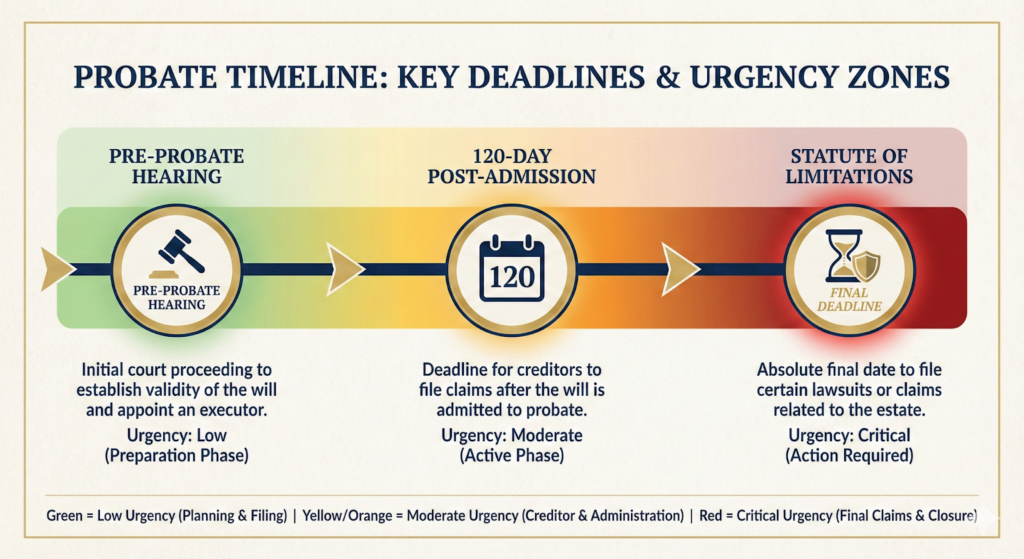
Contesting a will in California involves multiple overlapping deadlines. Missing any one of them can permanently eliminate your right to challenge the document.
Before Probate (Pre-Admission Contest)
Any interested person can file objections before the will is officially admitted to probate. This is typically done by filing a written objection to the Petition for Probate and appearing at the initial hearing. At this stage, the proponent of the will has the burden of proving due execution under §8252(a). There is no fixed deadline — the objection must be filed before the hearing date — but probate hearings are often scheduled within 30 to 45 days of the petition filing.
After Probate (Post-Admission Contest)
Once the will has been admitted to probate, any interested person has 120 days to file a contest under Probate Code §8270. This is the most commonly applicable deadline. The 120-day clock starts from the date the will is admitted, and there is no extension for good cause. If you are a trust beneficiary, a parallel 120-day deadline runs from the date you receive a trustee notification under Probate Code §16061.7.
Statute of Limitations for Underlying Claims
Certain claims that accompany a will contest have their own deadlines: three years for fraud under Code of Civil Procedure §338(d), four years for breach of fiduciary duty, and the applicable limitations period for any financial elder abuse claims filed alongside the contest.
What a Trust Litigation Attorney Actually Does in Court
Contesting a will is not a single filing — it is a litigation process that can take 12 to 24 months from petition to resolution. The Legacy Lawyers’ approach to will contest litigation follows a structured sequence developed through hundreds of cases in Los Angeles, Orange County, and throughout Southern California.
Phase 1: Case Evaluation and Evidence Assessment (Weeks 1–4)
Before any filing, The Legacy Lawyers’ litigation team conducts a comprehensive evaluation. This includes reviewing the will and any prior versions, obtaining the testator’s medical records for the period surrounding execution, interviewing witnesses who had contact with the testator, and analyzing the circumstances of the will’s preparation — who initiated it, which attorney drafted it, and who was present at the signing. The goal is to determine whether probable cause exists to support the contest, which is essential both for the legal merits and for navigating any no-contest clause.
Phase 2: Filing the Contest Petition (Month 1–2)
The contest petition must specifically identify the grounds under §8252 and include all supporting facts. If financial elder abuse is also present — as it often is when undue influence is involved — The Legacy Lawyers files a concurrent financial elder abuse claim alongside the will contest. This combined approach unlocks mandatory attorney’s fees under Welfare & Institutions Code §15657.5 and Probate Code §859 double damages, remedies that a standalone will contest does not provide.
Phase 3: Discovery (Months 3–10)
Discovery is where will contests are won or lost. The process includes depositions of the person who allegedly exerted undue influence, as well as the attorney who drafted the will, any witnesses to the signing, and caregivers or medical professionals who treated the testator. Subpoenas are issued to banks, brokerage firms, and financial institutions to trace any unusual transfers or account changes around the time of execution. Forensic document examiners may analyze signatures, handwriting, and the physical document itself. Neuropsychological experts review medical records and may offer opinions on the testator’s capacity at the time of signing. The Legacy Lawyers’ litigation team works with California-licensed forensic accountants and investigators who specialize in uncovering the financial relationships and transactions that reveal the real story behind a suspicious will.
Phase 4: Mediation and Settlement Negotiations (Months 8–14)
Most California will contests settle before trial. The Legacy Lawyers reports that approximately 85% of their trust litigation cases resolve through negotiation or mediation. Settlement in will contest cases typically involves a negotiated redistribution of estate assets, modification or elimination of contested provisions, and agreements regarding executor or trustee appointment. Settlement negotiations are often most productive after discovery has revealed the strength (or weakness) of each side’s evidence. The threat of a no-contest clause cuts both ways — it can deter a contestant from filing, but once a contest is filed with probable cause, the proponent faces the risk that the will may be entirely invalidated at trial.
Phase 5: Trial (Months 12–24)
Will contests in California probate court are bench trials — decided by a judge, not a jury. Under §8252(a), the proponent bears the burden of proving due execution, while the contestant bears the burden on all other grounds (capacity, undue influence, fraud, duress, mistake, revocation). Trials typically last three to five days, with courts issuing decisions within approximately 30 days. The trial involves opening statements, direct and cross-examination of witnesses, presentation of expert testimony, and admission of documentary evidence. If the court invalidates the will, the estate reverts to the most recent valid will or, if none exists, to California’s intestacy laws.
Who Can Contest a Will in California
Not everyone has legal standing to contest a will. Under California law, the following parties can file a contest:
- Beneficiaries named in the will or in a prior version of the will
- Heirs at law who would inherit under California’s intestacy statutes if the will were invalidated
- Creditors who have claims against the estate
- The executor named in the will
- Any individual who was financially dependent on the decedent
Standing is a threshold requirement. If the court determines you do not have standing, your contest will be dismissed before the merits are ever reached.
Conclusion
In Meiri v. Shamtoubi, a beneficiary with potentially valid claims of undue influence and fraud lost her entire inheritance — not because the court found the trust was properly executed, but because she filed 110 days late. That outcome illustrates the central tension of contesting a will in California: the law provides seven specific grounds to challenge an invalid document, but the procedural requirements are absolute. No-contest clauses punish poorly timed filings. The 120-day deadline after probate admission or trustee notification is inflexible. And the probable cause standard requires evidence before you file, not after.
If you believe a loved one’s will does not reflect their true wishes — because of cognitive decline, manipulation by a caregiver, isolation from family, or suspicious last-minute changes — the single most important step is consulting a trust litigation attorney before any deadline passes. Every day that passes reduces your options and your leverage.
Call The Legacy Lawyers at (800) 840-1998 to schedule a free consultation. Our litigation team will evaluate your grounds, assess the evidence, determine whether a no-contest clause applies, and outline the specific steps to protect your inheritance.
FAQ SECTION
What are the legal grounds for contesting a will in California?
Under Probate Code §8252, the seven grounds are lack of due execution, lack of testamentary intent or capacity, undue influence, fraud, duress, mistake, and revocation. Each requires specific evidence — you cannot contest a will simply because you disagree with the distribution.
How long do I have to contest a will in California?
You have 120 days after the will is admitted to probate to file a post-admission contest under Probate Code §8270. You can also object before admission at the initial probate hearing. Missing the 120-day deadline can permanently bar your claim.
Will I lose my inheritance if I contest a will with a no-contest clause?
Not if you have probable cause. Under Probate Code §21311, a no-contest clause can only be enforced against a direct contest brought without probable cause. If a reasonable person would believe your contest has a reasonable likelihood of success, the clause does not apply.
What happens if I file a will contest late in California?
In Meiri v. Shamtoubi (2022) 81 Cal.App.5th 606, the court ruled that an untimely contest automatically lacks probable cause. The beneficiary filed 230 days after notification and was completely disinherited under the trust’s no-contest clause.
How long does a will contest take in California?
Most will contests take 12 to 24 months from filing to resolution. Approximately 85% settle before trial through negotiation or mediation. When cases go to trial, the bench trial typically lasts three to five days, with a decision issued within about 30 days.
DISCLAIMER
This article references publicly available information including California Probate Code sections 6100.5, 6110, 8252, 8270, 21311, and 21380; California Welfare & Institutions Code sections 15610.70 and 15657.5; and published Court of Appeal decisions including Meiri v. Shamtoubi (2022) 81 Cal.App.5th 606, White v. Wear (2022) 76 Cal.App.5th 24, Andersen v. Hunt (2011) 196 Cal.App.4th 722, Bounds v. Superior Court (2014) 229 Cal.App.4th 468, and In re Estate of Perkins (1925) 195 Cal. 699, as well as case summaries published by the California Lawyers Association and the Daily Journal, dated 1925–2026. All metrics and quotes are from documented sources. Results described are specific to the cases cited and may vary based on jurisdiction, facts, and circumstances. For current information about trust litigation services, consult The Legacy Lawyers directly at thelegacylawyers.com.
