
A 2025 Caring.com study found that only 24% of Americans have a will in place. For those who do create one, choosing the right beneficiaries remains one of the most important decisions in estate planning. Under California Probate Code Section 24, a beneficiary is defined as “a person to whom a donative transfer of property is made.” Understanding the different types of beneficiaries helps ensure your assets reach the people and causes you care about most.
This guide explains the five main beneficiary types recognized under California law. You will learn how each type works, when to use them, and common mistakes to avoid.
What Makes Someone a Beneficiary Under California Law

California Probate Code Section 24 provides the legal definition that governs all beneficiary designations in the state. According to this statute, a beneficiary means “a person to whom a donative transfer of property is made or that person’s successor in interest.”
The code further specifies that beneficiaries fall into different categories depending on the type of estate document involved. For a testate estate (one with a valid will), the beneficiary is called a “devisee.” For an intestate estate (one without a valid will), beneficiaries are called “heirs” and are determined by California’s succession laws under Probate Code Sections 6401 and 6402.
The distinction matters because beneficiaries are chosen by the person making the will. Heirs, by contrast, are determined automatically by state law when no will exists. This is why having a properly drafted will with clearly identified beneficiaries gives you control over your legacy.
Primary Beneficiaries: Your First Choice Recipients
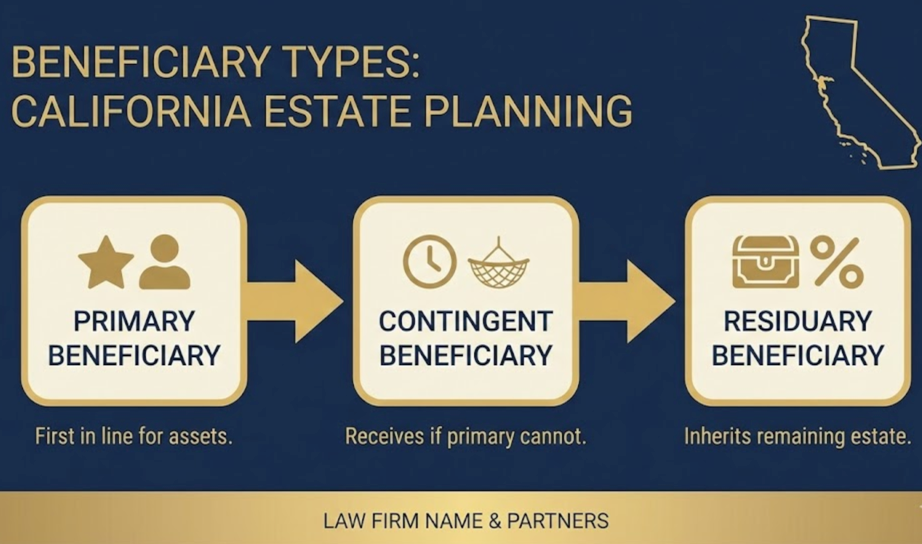
A primary beneficiary is the person or organization you want to receive your assets first. These are your main choices for inheriting specific property or portions of your estate.
Under California law, you can name almost anyone as a primary beneficiary. This includes your spouse or domestic partner, children, other family members, friends, or charitable organizations registered with the California Attorney General’s office.
When naming primary beneficiaries, California law requires clarity. According to estate planning guidance from the California State Bar, you should include full legal names, relationship to you, and current contact information. For charitable organizations, include the entity’s Employer Identification Number (EIN) to avoid confusion if multiple organizations share similar names.
California is a community property state, which affects beneficiary designations for married couples. Under Probate Code Section 6401, a surviving spouse automatically receives the deceased spouse’s share of community property. For separate property, the spouse’s share depends on whether there are surviving children or other relatives.
You can name multiple primary beneficiaries and divide your assets using percentages rather than fixed dollar amounts. This approach accounts for changes in asset values over time.
Contingent Beneficiaries: Your Essential Backup Plan
A contingent beneficiary receives your assets only if your primary beneficiary cannot. This situation arises when a primary beneficiary dies before you, cannot be located, or declines the inheritance.
California courts consistently emphasize the importance of naming contingent beneficiaries. Without them, assets intended for a deceased primary beneficiary may need to go through probate court, which the California Judicial Council reports can take anywhere from eight months to several years.
The process works in sequence. First, your executor attempts to distribute assets to primary beneficiaries. Only when all primary beneficiaries are unable to receive their shares do contingent beneficiaries step in. According to the California Probate Code, you can name multiple contingent beneficiaries in a specific order of priority.
Consider this example from California estate planning practice. A parent names their spouse as primary beneficiary and their two adult children as contingent beneficiaries. If the spouse passes away before the parent, the children would then receive the inheritance instead.
Naming contingent beneficiaries helps your estate avoid intestate succession. Under Probate Code Section 6402, when no beneficiary can be found, assets pass to relatives in a specific order established by law. If no relatives exist, assets “escheat” to the State of California.
Residuary Beneficiaries: Catching What Remains
A residuary beneficiary receives whatever is left in your estate after specific gifts have been distributed and debts have been paid. This is sometimes called the “rest, residue, and remainder” of your estate.
California wills commonly include language such as: “The rest, residue, and remainder of my estate I leave to my surviving children in equal shares.” This provision ensures that no assets fall through the cracks.
Residuary beneficiaries serve two important functions under California law. First, they receive assets you did not specifically assign to anyone else. Second, they receive the share of any specific beneficiary who cannot accept their inheritance, when no contingent beneficiary has been named.
The California Statutory Will form, established under Probate Code Section 6240, includes a specific section for naming residuary beneficiaries. This standardized form recognizes that most people want their remaining assets distributed to family members rather than going through additional court proceedings.
Failing to name a residuary beneficiary can create complications. Any unassigned assets become part of your intestate estate, subject to distribution under Probate Code Sections 6401 and 6402 regardless of your other wishes.
Minor Beneficiaries: Special Rules for Children Under 18
California law does not allow minors to directly own property. Under the California Uniform Transfers to Minors Act (CUTMA), found in Probate Code Sections 3900 through 3925, special arrangements must be made when leaving assets to anyone under age 18.
When you name a minor as a beneficiary in California, you should also designate a custodian to manage those assets until the child reaches adulthood. The custodian has authority to invest and spend the assets for the minor’s benefit according to standards outlined in the Probate Code.
CUTMA allows you to specify when the minor will receive full control of the assets. The default age is 18, but California law permits you to delay the transfer until the beneficiary reaches age 21 for lifetime gifts, or up to age 25 for transfers made through a will or trust.
According to Probate Code Section 3912, custodians must observe “the standard of care that would be observed by a prudent person dealing with property of another.” This legal standard protects the minor’s inheritance while allowing reasonable flexibility in management.
If you fail to name a custodian and a minor inherits assets worth more than $5,000, the probate court must appoint a guardian of the estate. This process adds time and expense. Court-supervised guardianships require regular accountings and court approval for many financial decisions, unlike custodial arrangements under CUTMA.
For larger inheritances or those with complex requirements, many California estate planning attorneys recommend establishing a trust rather than relying solely on CUTMA provisions. Trusts offer more control over timing and conditions of distribution.
Charitable Beneficiaries: Supporting Causes You Care About
You can name charitable organizations as beneficiaries in your California will. The California Attorney General’s office maintains a Registry of Charities where you can verify that an organization is in good standing before including them in your estate plan.
As of June 2022, according to the California Department of Justice, thousands of charitable organizations operate within the state. When naming a charity as a beneficiary, include the organization’s full legal name, address, and EIN to ensure accurate identification.
Charitable beneficiaries can serve as primary, contingent, or residuary beneficiaries. Some California residents choose to leave a specific percentage of their estate to charity while leaving the remainder to family members.
California law requires that the Attorney General’s office receive notice when a will involves charitable gifts without a specifically identified charitable beneficiary, or when charitable assets may be affected by probate proceedings. This oversight protects charitable donations from misuse.
Charitable bequests may provide estate tax benefits depending on the size of your estate and current tax law. However, tax considerations should not be the primary reason for charitable giving in your will.
Class Gifts and Per Stirpes Distribution
California Probate Code Section 246 governs how assets are distributed when a beneficiary dies before the person who made the will. Two main methods exist: per stirpes and per capita.
Per stirpes, meaning “by the branch,” is California’s default distribution method. Under this approach, if a beneficiary dies before you, their share passes to their descendants in equal portions. For example, if you leave assets to your three children per stirpes and one child predeceases you leaving two grandchildren, those grandchildren would split their parent’s one-third share, receiving one-sixth each.
Per capita distribution divides assets equally among all surviving beneficiaries at the same generational level. Using the same example, a per capita designation would divide your estate equally between your two surviving children only, with your grandchildren receiving nothing.
According to California Probate Code Section 246(b), any will executed on or after January 1, 1986, that calls for distribution “per stirpes,” “by representation,” or “by right of representation” follows the per stirpes method unless the document specifically states otherwise.
Understanding this distinction matters for families with multiple generations. Your choice affects whether assets stay within family branches or are redistributed among survivors at the same level.
Common Mistakes When Naming Beneficiaries

Estate planning attorneys throughout California identify several recurring errors in beneficiary designations. Avoiding these mistakes helps ensure your wishes are followed.
Using vague descriptions instead of specific names creates ambiguity. Phrases like “my children” may seem clear, but questions arise if children are born after the will is signed or if stepchildren should be included. The California Probate Code requires clear identification of beneficiaries.
Forgetting to update beneficiaries after major life events causes problems. Marriage, divorce, births, and deaths all affect who should inherit. California law does not automatically revoke beneficiary designations after divorce in all circumstances, so reviewing your will after any significant life change is essential.
Naming minor children directly without custodial arrangements triggers court involvement. As discussed above, CUTMA requires adult custodians for minors receiving inheritances.
Failing to consider what happens if beneficiaries die simultaneously with you can leave assets in limbo. California’s Uniform Simultaneous Death Act provides default rules, but your will can specify different arrangements.
Not coordinating beneficiary designations across all assets leads to unintended results. Life insurance policies, retirement accounts, and payable-on-death accounts pass directly to named beneficiaries regardless of what your will says. These designations should align with your overall estate plan.
Taking Action: Your Next Steps
Properly naming beneficiaries in your California will protects your family and ensures your assets reach the people and causes you intend. Whether you need to create a new will or update existing beneficiary designations, working with an experienced California estate planning attorney helps avoid costly mistakes.
Review your current beneficiary designations at least once per year and after any major life event. Confirm that your choices still reflect your wishes and that all named individuals can be located if needed.
Frequently Asked Questions
Can I name my pet as a beneficiary in California?
No, California law does not allow pets to directly inherit. However, you can create a pet trust under Probate Code Section 15212 to provide for your animal’s care and name a trustee to manage those funds.
What happens if my named beneficiary refuses the inheritance?
Under California Probate Code Section 275, a beneficiary can disclaim their inheritance within nine months of the death. The assets then pass as if that beneficiary had predeceased you, typically going to contingent or residuary beneficiaries.
Do beneficiary designations on bank accounts override my will?
Yes. Payable-on-death (POD) accounts, life insurance policies, and retirement accounts transfer directly to named beneficiaries outside of probate, regardless of conflicting will provisions.
Can I disinherit a family member in California?
California allows you to exclude most relatives from your will. However, California Probate Code Section 21611 provides protections for spouses and domestic partners who were unintentionally omitted. Specific language should be used to make intentional disinheritance clear.
How often should I update my beneficiary designations?
Review beneficiaries annually and after major life events such as marriage, divorce, birth of children, or death of a named beneficiary. The California State Bar recommends scheduling regular reviews with your estate planning attorney.
This article references publicly available information from the California Legislative Information website, California Attorney General’s office, California Judicial Council, and California State Bar, including official documentation, statutes, and published guidance dated 2022-2025. All legal citations are from documented sources. The information provided is specific to California law and may vary in other jurisdictions. For current information about California probate law or assistance with your specific situation, consult the official California Probate Code or speak with a licensed California attorney.
