

The 2025 Trust & Will Estate Planning Report surveyed 10,000 respondents and found that 55% of Americans have no estate documents at all. For the remaining 45% who do have trusts, many beneficiaries remain unaware of the powerful legal protections California provides them. Understanding your rights under the California Probate Code can mean the difference between receiving your full inheritance within 12 to 18 months or waiting years while assets diminish. This guide breaks down exactly what California law guarantees you as a trust beneficiary, the critical deadlines you cannot miss, and the specific steps to protect your inheritance.
What California Trust Beneficiary Rights Are—Through the Legal Framework

California trust beneficiary rights derive primarily from Division 9 of the California Probate Code, which established comprehensive protections that became effective January 1, 1987, with significant amendments continuing through 2024.
Under California Probate Code Section 16060, trustees have a fundamental duty to keep beneficiaries “reasonably informed of the trust and its administration.” This provision, as interpreted by California courts, requires trustees to provide information relevant to beneficiaries’ interests without requiring formal requests in many circumstances.
The California Uniform Directed Trust Act and the Uniform Fiduciary Income and Principal Act became effective January 1, 2024, according to reporting from The National Law Review. These laws expanded trustee flexibility in managing unitrusts and allocating income while simultaneously reinforcing beneficiary protections through clearer fiduciary standards.
California law categorizes beneficiary rights into several distinct areas. First, beneficiaries maintain the right to receive a copy of the trust document. Under California Probate Code Section 16061.7, beneficiaries are entitled to receive copies of the trust document upon written request, including all current amendments. Second, beneficiaries possess the right to notification when trust status changes. When a revocable trust becomes irrevocable—typically upon the death of the settlor—the trustee must provide formal written notification to all beneficiaries and heirs.
These notification requirements serve a critical function. As outlined in guidance from California probate attorneys, the statutory notification must include the identity and contact information of the trustee, a statement of the recipient’s interest in the trust, and notification that the recipient has 120 days to contest the trust’s validity. This notification starts the statute of limitations clock for any legal challenges.
How California’s 60-Day and 120-Day Deadlines Protect Beneficiaries
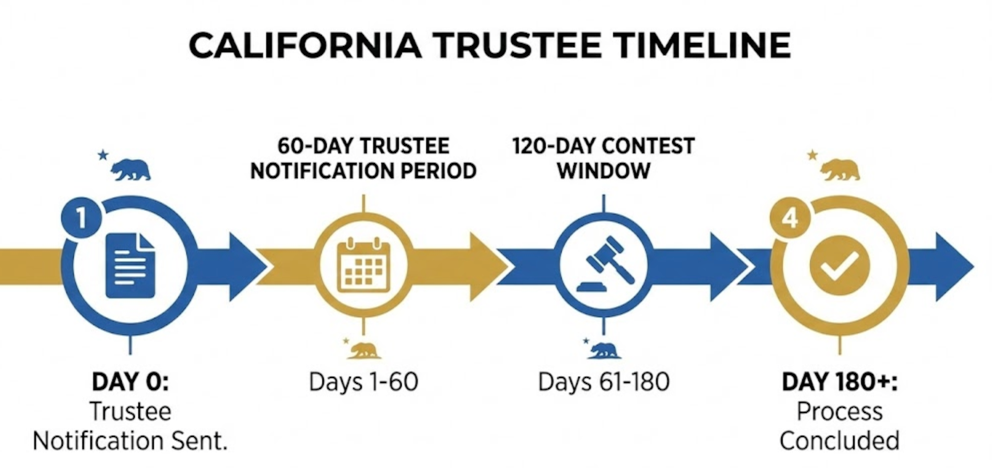
The California Probate Code establishes precise timelines that benefit both trustees and beneficiaries. According to California Probate Code Section 16061.7, subsection (f), the trustee notification must be served no later than 60 days following the event triggering notification or 60 days after the trustee becomes aware of a person entitled to receive notification.
The 120-day contest period represents one of the most critical deadlines in California trust law. As stated directly in the California Probate Code, beneficiaries and heirs “may not bring an action to contest the trust more than 120 days from the date this notification by the trustee is served upon you or 60 days from the date on which a copy of the terms of the trust is delivered to you during that 120-day period, whichever is later.”
This timeline creates specific strategic considerations. If a beneficiary requests a copy of the trust document during the initial 120-day period, they receive an additional 60 days from the delivery date to file a contest. This extension provides crucial time for beneficiaries to review complex trust documents with legal counsel.
Failure to act within these windows carries permanent consequences. According to California trust litigation attorneys, if no trust contest lawsuit is filed within the 120-day deadline, the trust becomes legally presumed valid, and heirs and beneficiaries are forever barred from challenging its validity in court.
The consequences for trustees who fail to provide required notifications are equally significant. California Probate Code Section 16061.9 specifies that a trustee who fails to serve notification as required shall be responsible for all damages, attorney’s fees, and costs caused by the failure unless the trustee demonstrates a reasonably diligent effort to comply.
Measurable Protections: Trust Accounting Requirements and Enforcement
California Probate Code Section 16062 establishes mandatory accounting requirements that provide beneficiaries with concrete financial transparency. The code requires trustees to account at least annually, at the termination of the trust, and upon a change of trustee, to each beneficiary entitled to receive distributions.
According to California Probate Code Section 16063, a proper trust accounting must contain specific elements. These include a statement of receipts and disbursements of principal and income during the accounting period, a statement of the trust’s assets and liabilities, the trustee’s compensation, identification of agents hired by the trustee along with their compensation, a statement that the beneficiary may petition the court for review, and a statement that claims against the trustee for breach of trust may not be made after three years from receipt of an accounting disclosing the relevant facts.
The enforcement mechanism is equally clear. Under California Probate Code Section 16061, beneficiaries who make reasonable written requests for information must receive responses within 60 days. If a trustee fails to respond, this failure may constitute a breach of fiduciary duty, according to legal analysis of the code.
Beneficiaries possess multiple enforcement options when trustees fail to meet their obligations. These include petitioning the probate court to compel an accounting, seeking court-ordered trustee removal, and pursuing surcharges against trustees for financial harm caused by breaches.
Comparing California’s Trust Laws to National Standards
California’s trust beneficiary protections reflect both national trends and state-specific innovations. The Uniform Trust Code, adopted in various forms by many states, provides a baseline for beneficiary rights. California’s approach, while not adopting the UTC wholesale, incorporates many parallel protections.
The 2024 legislative session produced several significant changes affecting trust administration. Assembly Bill 2016 passed the California Legislature on August 29, 2024, and was approved by Governor Gavin Newsom on September 21, 2024, according to The National Law Review. This legislation modified small estate probate procedures, raising thresholds to reflect increasing California property values.
Assembly Bill 2148 strengthened oversight of professional fiduciaries through the Professional Fiduciaries Bureau. Professional fiduciaries in California are now held to higher standards than lay trustees, with enhanced licensing requirements and regulatory oversight.
California’s approach to trust accounting waivers demonstrates the state’s beneficiary-focused framework. While trust documents may include provisions waiving accounting requirements, California Probate Code Section 16062, subsection (e) declares that any such waiver is void as against public policy when the sole trustee is a disqualified person as defined in the code. This protection prevents potential bad actors from using trust language to shield misconduct from beneficiary oversight.
Trust administration timelines in California reflect both legal requirements and practical realities. According to multiple California probate resources, the typical trust administration takes between 12 to 18 months to complete. The process can take significantly less time, ranging between 4 to 5 months, when distribution terms are straightforward. Conversely, disputes among beneficiaries, complex assets, or tax complications can extend administration beyond 18 months.
Practical Implementation Guide for California Trust Beneficiaries
Successful protection of beneficiary rights requires proactive steps based on California’s legal framework.
Upon learning of your status as a beneficiary, you should immediately document the date you received any notification from the trustee. This date triggers your 120-day contest window, making accurate records essential. Within the first week, submit a written request for a complete copy of the trust document and all amendments. Under California Probate Code Section 16061.7, you are entitled to this documentation.
During the first 30 days, review the trust document carefully, ideally with legal counsel experienced in California trust law. Identify your specific entitlements, distribution timelines, and any conditions attached to your inheritance. Note whether the trust contains provisions that may affect your rights, such as no-contest clauses.
Between days 30 and 90, if you have concerns about the trust’s validity—such as questions about the settlor’s mental capacity, potential undue influence, or improper execution—consult with a California trust litigation attorney immediately. The 2024 Court of Appeal decision in Key v. Tyler reinforced that no-contest clauses carry significant consequences, and beneficiaries who litigate against trusts risk total disinheritance.
If the trustee fails to provide required information or accounting, submit a formal written demand. Document this request through certified mail. Under California law, the trustee has 60 days to respond to reasonable information requests. If the trustee fails to respond, you may file a petition with the probate court under California Probate Code Section 17200.
For ongoing administration, request annual accountings as required by California Probate Code Section 16062. Review these documents carefully for discrepancies. The three-year statute of limitations for breach of trust claims begins running when you receive an accounting that discloses facts giving rise to a potential claim.
Consider whether preliminary distributions are appropriate. Trustees may distribute portions of a beneficiary’s inheritance before final administration concludes, provided sufficient assets remain to cover all trust obligations. However, this decision rests with the trustee’s judgment and fiduciary duties.
Conclusion
The 2025 Trust & Will Estate Planning Report’s finding that 55% of Americans lack estate documents underscores the importance of understanding your rights when you are named as a beneficiary. California’s Probate Code provides robust protections—including the 60-day notification requirement, 120-day contest window, and mandatory annual accounting—but these protections only help beneficiaries who know how to use them.
Your specific next step: Within 48 hours of receiving any trustee notification, send a certified letter requesting a complete copy of the trust document and all amendments. This single action extends your contest deadline by 60 days and establishes documentation that protects your rights throughout the administration process.
Frequently Asked Questions
How long does a trustee have to notify beneficiaries in California?
Under California Probate Code Section 16061.7, trustees must serve notification within 60 days of the triggering event, such as the settlor’s death or a change in trustee.
What is the deadline to contest a trust in California?
Beneficiaries have 120 days from receiving the trustee’s notification, or 60 days from receiving a copy of the trust terms during that period, whichever is later.
Can a California trustee refuse to provide an accounting?
Unless the trust document specifically waives this requirement for non-disqualified trustees, California Probate Code Section 16062 mandates annual accountings to beneficiaries entitled to distributions.
How long does California trust administration typically take?
According to California probate resources, typical trust administration takes 12 to 18 months, though straightforward distributions may complete in 4 to 5 months.
What happens if a California trustee ignores my requests for information?
Beneficiaries may petition the probate court under California Probate Code Section 17200 to compel trustee compliance, and courts may award attorney’s fees for unreasonable trustee refusals.
This article references publicly available information from the California Legislative Information database, California Courts Self-Help Center, The National Law Review, Trust & Will, and AARP, including official documentation, legal codes, and published studies dated 2023 through 2025. All metrics and legal citations are from documented sources. Legal requirements described are specific to California and current as of publication. For current information about California probate law or specific legal situations, consult the official California Courts website or a licensed California attorney.
