

You’re a few weeks out from losing your spouse. Someone mentioned the spousal property petition California deadline — the fast track that can save you from full probate. Now you’re wondering how long you have to file it, and whether you’ve already missed the window.
Good news. California law does not give the spousal property petition itself a hard deadline. You don’t lose the right just because a few months went by. The bad news is that a handful of other deadlines sit right next to this petition, and any one of them can bite you if you ignore it. Here’s what actually matters on the calendar, in plain English.
The Short Answer
There is no strict statutory deadline to file a spousal property petition in California. The petition lives in Probate Code section 13500, and the code does not set a filing cutoff.
You can file it a month after death. You can file it a year later. In theory, you can file it years later, as long as the property still needs to be confirmed as yours.
But “no strict deadline” is not the same as “take your time.” Waiting too long causes real problems — banks freeze accounts, title companies won’t let you sell, other deadlines quietly pass, and evidence gets harder to find. So the practical answer is: file within a few months of death if you can, ideally within six months. Not because the law forces you to, but because life does.
The Real Deadlines to Watch
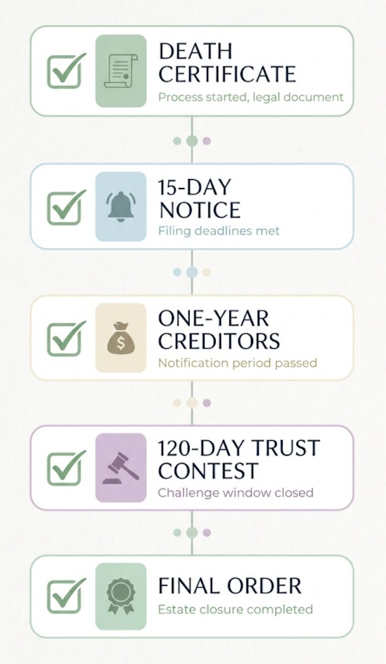
Even without a hard filing cutoff, several time windows move around this petition. These are the ones that actually matter.
The 15-Day Notice of Hearing
Once you file the petition, the court sets a hearing date — usually 30 to 45 days out. You have to give written notice of that hearing to every interested party at least 15 days before it happens.
Interested parties include:
- All heirs of your deceased spouse
- The executor or administrator of the estate (if a regular probate has already been started)
- Anyone who asked for special notice under Probate Code section 1250
- The California Attorney General, in the rare case where the will includes a charitable gift with no named trustee
Miss the 15-day notice and the court will usually continue the hearing — pushing your whole timeline back by another month or two. This is the single most common delay.
The 120-Day Trust Contest Window
If your spouse had a trust, anyone who wants to challenge it has 120 days from the trustee’s notice to file a contest. This is a separate process from the v, but it often runs alongside it. Do not let this window close without knowing where you stand.
The One-Year Creditor Period
When you receive property through a spousal property petition California deadline, you take it subject to your deceased spouse’s unsecured debts — up to the value of what you received. Creditors generally have one year from the date of death to come forward. It affects how carefully you handle the property after it’s confirmed as yours.
The 4-Day Order Deadline
This one is easy to miss. On top of the petition itself, you have to prepare a Spousal Property Order — Form DE-226 — and get it to the court clerk at least four days before the hearing.
Show up without the proposed order and the judge usually can’t grant your petition that day. You get sent home to come back another time.
The 120-Hour Survivorship Rule
If your spouse died without a will and you are inheriting under intestate rules, you have to survive them by at least 120 hours — five full days. This comes from Probate Code section 1. It doesn’t affect the petition itself, but it affects whether you qualify to file one under intestacy.
The Typical Timeline
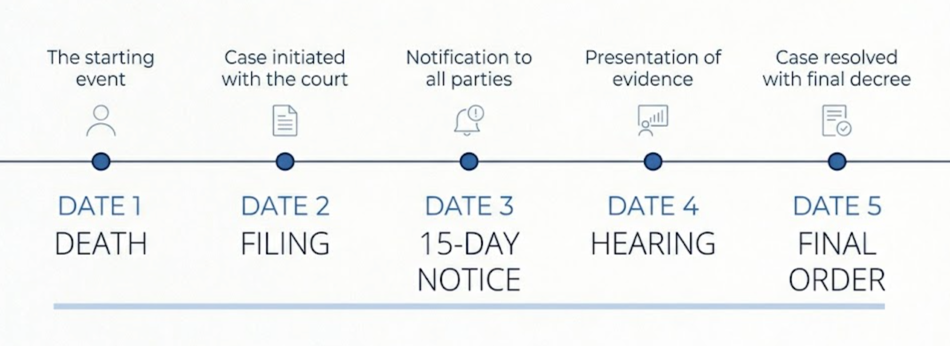
If nothing goes wrong, here’s roughly what a California spousal property petition looks like from start to finish.
- Week 1 to 4 after death. Gather the death certificate, marriage certificate, the will (if there is one), and property records. Build a list of every asset you want to transfer.
- Month 2 or 3. File the petition with the Superior Court in the county where your spouse lived. The filing fee is roughly $435. The clerk sets a hearing date, usually 30 to 45 days out.
- At least 15 days before the hearing. Serve the notice of hearing on all interested parties.
- At least 4 days before the hearing. File your proposed Spousal Property Order with the clerk.
- Hearing day. The judge reviews the petition. If everything is in order, the petition is granted on the spot.
- After the hearing. You get a certified copy of the signed order. Use it to update titles at the County Recorder, transfer bank accounts, and move brokerage assets into your name.
Total: usually 2 to 4 months. If there is a continuance — the most common reason for delay — plan on 4 to 6 months. If someone objects, it can stretch longer.
What Slows Things Down — and When Speed Matters
A few situations will add weeks or months to the process. The most common delay is missed or incomplete notice — if you forget even one interested party, the court usually continues the hearing by 30 to 60 days. Other slowdowns: an heir objecting over whether the asset was truly community property, missing paperwork at the hearing, using the wrong form, or a busy probate calendar in a high-volume county.
On the flip side, a few situations make filing quickly much more important than the “no strict deadline” rule would suggest. You need to file fast if household expenses depend on accounts frozen in your spouse’s name, if you plan to sell or refinance the house (title companies won’t close until the transfer is confirmed), if another heir might open a full probate first, or if a 120-day trust contest window is running in the background.
What to Do This Week
If you are thinking about a spousal property petition in California, here’s the short list.
- Get ten certified copies of the death certificate. Banks, title companies, and the court all want them.
- Gather the paperwork. Marriage certificate, will or trust if any, deeds, and statements for every account you want to transfer.
- Make a list of every interested party. Every heir, every person named in a will, anyone who asked for special notice. This becomes your service list.
- Check the court’s local rules. Filing fees and procedures can vary slightly by county.
- Talk to a California probate attorney before you file. The petition is technically DIY-friendly, but one missed notice or a wrong form resets the whole timeline. An attorney review is usually a few hundred dollars and saves weeks.
Most of these steps take hours, not days. Together they keep the process on track.
The Bottom Line
There is no hard filing deadline for a California spousal property petition. What there is, instead, is a chain of smaller deadlines around it — the 15-day notice, the 4-day order filing, the 120-day trust contest, the one-year creditor period. Miss any one of them and your clean 2-to-4-month process can stretch to six months or more.
The safest rule of thumb: file within a few months of your spouse’s death, and treat every notice requirement as a real deadline, not a suggestion.
What to do this week: gather your paperwork, make your list of interested parties, and book a 30-minute call with a California probate attorney to confirm your timeline. That short conversation is the single cheapest way to keep this petition on the fast track it was designed for.
FAQ Section
Is there a strict deadline to file a spousal property petition in California?
No. California Probate Code section 13500 does not set a statutory filing deadline. That said, most surviving spouses file within a few months of death because banks, title companies, and other institutions won’t release assets until the transfer is confirmed.
How long does a spousal property petition usually take in California?
Usually 2 to 4 months from filing to a signed order. If the hearing gets continued — because of missing notice, incomplete documents, or an objection — it can stretch to 4 to 6 months or longer.
What happens if I miss the 15-day notice of hearing?
The judge will almost always continue the hearing to a later date. That typically pushes your timeline back by 30 to 60 days. It doesn’t kill your petition, but it is the single most common reason these cases get delayed.
Can I file a spousal property petition years after my spouse’s death?
Yes, in most cases. The petition itself has no cutoff. But after long delays, documents get lost, heirs may be harder to locate, and other deadlines — like the 120-day trust contest — may already have passed.
What if a regular probate is already open for my spouse’s estate?
You can still file a spousal property petition for assets passing to you, even if a full probate has been opened. The two processes can run in parallel, with the petition transferring your community property share and probate handling the rest.
Disclaimer
This article references publicly available information from the California Legislature and the California Courts self-help website, including California Probate Code sections 1250, 6403, 13500, and the framework for Forms DE-221 and DE-226, current through April 2026. All references are to documented California law and official court resources. Results are specific to California; outcomes in any individual matter depend on the specific facts, documents, and county of filing. This article is for informational purposes only and does not constitute legal advice. For current information, visit leginfo.legislature.ca.gov or selfhelp.courts.ca.gov, or consult a California-licensed attorney.