

Are You surviving spouse rights California just lost your husband or wife. Between the phone calls and the paperwork, someone hands you a stack of estate documents and asks what you want to do with the house. And you realize you have no idea what’s yours.
In California, the answer is probably more than you think. The law does not wait for a will to be read. The minute your spouse dies, you already own half of the community property — by law. And there are a few other protections most surviving spouses never even ask for. Here’s what California actually gives you, in plain English.
What You Already Own

California is a community property state. That one rule changes everything.
Community property is anything you and your spouse earned or bought during the marriage. Paychecks. The house. The retirement account that grew while you were together. It doesn’t matter whose name is on the deed or the paystub. It’s owned 50/50.
So on the day your spouse dies, half of all of that is already yours. Not “you might get it.” Not “if the will says so.” Yours.
Your spouse could only leave their half in a will or trust. Your half can’t be touched by any estate document, because it was never theirs to give.
This is the foundation of every surviving spouse right in California. Everything else builds on it.
If There Was No Will
When a spouse dies without a will in California, the state has a default plan. It strongly favors the surviving spouse.
Here’s how it works for community property. You already owned half. You now inherit the other half too. You end up with 100% of the community property. Full stop.
Separate property is where it gets a little more complicated. Separate property is what your spouse owned before the marriage, or received as a gift or inheritance during it. How much you get depends on who else survived.
- No surviving kids, parents, or siblings. You inherit all of the separate property.
- One child, or grandchildren from one deceased child. You inherit half. The child or grandchildren get the other half.
- Two or more children, or the parents with no kids. You inherit a third. The rest goes to them.
The same rules apply to registered domestic partners.
One small but important catch: you have to survive your spouse by at least five days to inherit. If you both die in the same accident and you pass a few hours later, the law treats you as if you didn’t survive at all.
If There Was a Will
A will can never override your community property rights. Your half is yours, period.
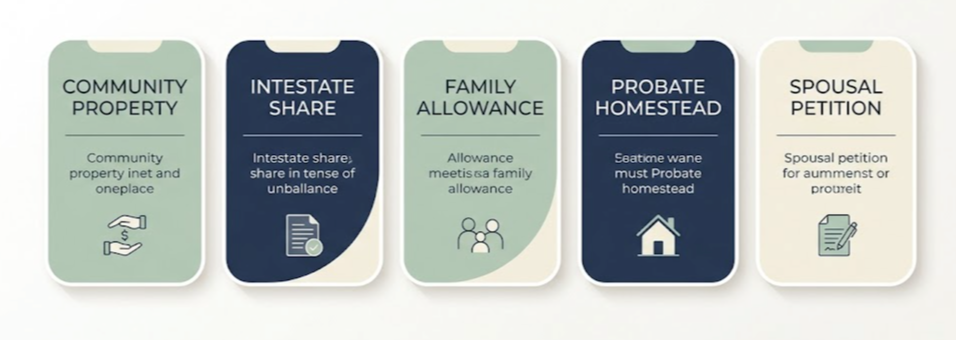
But California also protects you if the will shortchanges you in other ways. Here are the four biggest protections.
The omitted spouse rule. If your spouse wrote their will before you got married and never updated it, you’re probably what California law calls an “omitted spouse.” You get roughly the same share you would have received if there were no will at all — unless the will clearly says the omission was on purpose, or your spouse provided for you some other way, or you signed a valid waiver like a prenup.
The family allowance. You can ask the probate court for a cash allowance from the estate to help you maintain your standard of living while probate is pending. It gets paid before most creditors. It can even be backdated to the date of death. It ends when probate closes or if you remarry.
The probate homestead. A court can let you stay in the family home even if the will leaves it to someone else. For a surviving spouse, this can last for your lifetime in some cases, as long as you don’t remarry.
Temporary possession of the home. This one is automatic. From the moment of death until 60 days after the probate inventory is filed, you have the right to stay in the home and keep the furniture, clothing, appliances, and the car. No petition required at first.
These rights stack. Many surviving spouses qualify for more than one at the same time.
The Fastest Path Through Probate
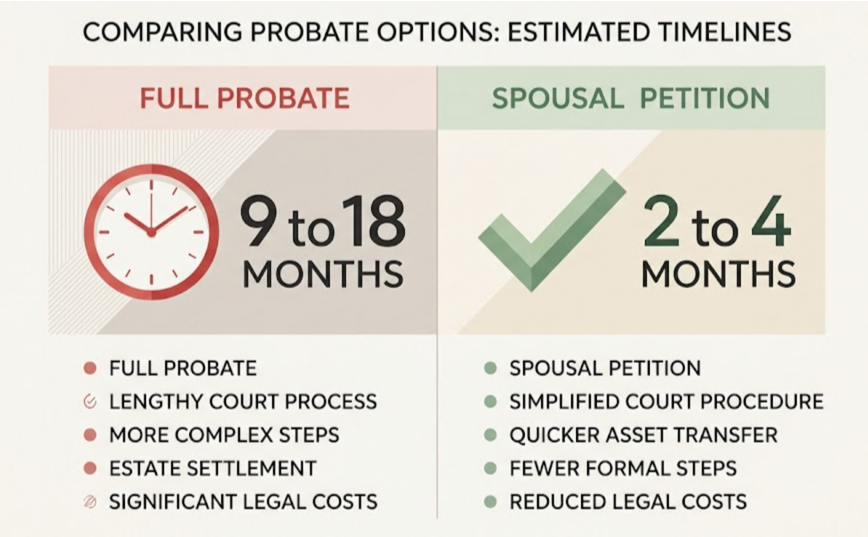
Here’s a right most surviving spouses have never heard of: the spousal property petition. It’s in Probate Code section 13500, and it can cut months off the process.
If property is passing to you — whether because it was community property or because the will or intestate rules give it to you — you don’t have to go through full probate. You file a spousal property petition instead. The court confirms the property is yours and issues an order transferring it.
The difference is big. Full probate in surviving spouse rights California usually takes 9 to 18 months and costs thousands in fees. A spousal property petition usually resolves in 2 to 4 months with far less paperwork.
This works for houses, bank accounts, brokerage accounts, and other assets passing to the spouse. It doesn’t work for assets passing to someone else.
If you’re a surviving spouse and nobody has mentioned this to you yet, ask about it.
What Skips Probate Entirely
Some assets never touch probate at all. They go straight to you, usually within weeks.
- Joint tenancy with right of survivorship. If the house or bank account was held this way, it passes to you automatically. A certified death certificate is often all you need.
- Community property with right of survivorship. A common California way to title real estate that transfers automatically on death.
- Named beneficiary accounts. Life insurance, 401(k)s, IRAs, and payable-on-death accounts go straight to whoever is named. Check every account. This is where estate plans quietly fall apart.
- Living trust assets. Anything titled in a revocable living trust passes according to the trust with no probate at all.
This is why funding a trust during the marriage matters so much. An empty trust controls nothing. A fully funded trust can skip probate almost entirely.
The Situations That Get Messy
Most surviving spouse cases are clean. But a few situations can shift your rights, and they’re worth knowing.
You were legally separated. If you had a formal separation judgment — not just an informal split — your inheritance rights may be limited. A written property settlement agreement can also change things.
You signed a prenup or postnup. A valid waiver can wipe out most of the rights discussed here. But the waiver has to be properly signed and fully informed. A rushed prenup from the week of the wedding often doesn’t hold up.
Assets got mixed. If separate money was deposited into joint accounts or used to pay the mortgage on a jointly owned house, figuring out who owns what becomes a paper chase.
Blended family. Kids from a prior marriage often challenge distributions. Your community property is still protected, but separate property splits can get contested.
In any of these situations, the exact outcome depends on evidence and documents that are rarely in one place.
What to Do This Week
If you’re a surviving spouse in California, here’s the short list.
- Get ten certified copies of the death certificate. Banks, title companies, and benefit providers will each want one.
- Don’t sign anything under pressure. Especially anything that looks like a waiver, a release, or a buyout.
- Pull every asset statement. Make a list of accounts, deeds, titles, and beneficiary designations. This is the paper trail that drives every right discussed above.
- Ask about a spousal property petition. If most of what you’re inheriting came from community property or is passing to you under the will, this fast-track may save you months and thousands of dollars.
- Talk to a California probate attorney before any deadlines pass. The family allowance, probate homestead, omitted spouse claim, and any potential will contest all have filing windows.
Most of these steps take hours, not days. Together they protect the rest of your life.
The Bottom Line
When a spouse dies in California, the law is already on your side. You own half of the community property by default. The other half usually comes to you too. On top of that, you can claim a family allowance during probate, stay in the family home, and use the spousal property petition to skip most of the slow part of probate.
None of this happens automatically. You have to know the rights exist and ask for them. That’s really what this whole guide is about.
What to do this week: make that list of accounts and titles, then book a 30-minute call with a California probate attorney to walk through which protections apply to you. That conversation is the cheapest and most important step in this whole guide.
FAQ Section
Not always. The surviving spouse inherits 100% of community property. But separate property is split with any surviving children, parents, or siblings. Only when there are no other close relatives does the spouse inherit all separate property too.
Five full days — 120 hours. If the surviving spouse dies within that window, California law treats them as if they did not survive for inheritance purposes.
It’s a fast-track under Probate Code section 13500 that lets a surviving spouse confirm ownership of inherited property without full probate. It usually takes 2 to 4 months instead of 9 to 18, and it costs much less.
Yes. You automatically have the right to stay in the home until 60 days after the probate inventory is filed. You can also petition for a probate homestead, which can extend for life in some cases if you don’t remarry.
You can petition for a family allowance. It’s a court-ordered cash allowance from the estate, paid before most creditors, to keep you going while probate is pending.
Surviving spouse rights in California include the right to keep the spouse’s own half of community property and, in many cases, receive additional property from the deceased spouse’s estate. These rights can apply whether there is a will, no will, or a trust involved.
Yes, a surviving spouse already owns half of the community property because it belongs to both spouses during the marriage. The deceased spouse’s estate documents can only control the deceased spouse’s half, not the surviving spouse’s existing share.
If a spouse dies without a will in California, intestate succession rules decide who inherits. The surviving spouse generally receives all community property, but separate property may be divided with surviving children, parents, or siblings, depending on the family situation.
No, a will cannot override the surviving spouse’s community property rights. Even if the will leaves everything to someone else, the surviving spouse can still claim the share that already belongs to them under California law.
A spousal property petition is a faster probate court process that can confirm property passing to a surviving spouse. It may help avoid full probate for property that belongs to the spouse or is passing to the spouse through inheritance rights.
A spousal property petition is useful when most or all of the property is passing to the surviving spouse. It can often save time and reduce court involvement compared to a full probate case, especially for community property, bank accounts, brokerage accounts, or real estate.
A family allowance is a court-approved payment from the estate that can help a surviving spouse maintain support while probate is pending. This protection can be important when estate assets are tied up, and the spouse needs financial stability during the court process.
A surviving spouse may have rights to remain in the family home during probate, including temporary possession rights and possible probate homestead protections. These rights can be especially important when other beneficiaries are pressuring the spouse to move out or sign documents quickly.
Assets held in joint tenancy, community property with right of survivorship, properly funded living trusts, and accounts with valid beneficiary designations can often skip probate. Reviewing titles, account statements, and beneficiary forms is one of the first steps after a spouse dies.
A surviving spouse should collect certified death certificates, gather account and title documents, avoid signing releases under pressure, and ask whether a spousal property petition is available. They can contact The Legacy Lawyers or call (800) 840-1998 to review surviving spouse rights before probate deadlines pass.
Disclaimer
This article references publicly available statutes from the California Legislature, including California Family Code section 760 and Probate Code sections 6401, 6403, 13500, 21610, along with the general framework for family allowance and probate homestead protections, current through April 2026. All references are to documented California law. Results are specific to California; outcomes in any individual matter depend on the specific facts, assets, and documents involved. This article is for informational purposes only and does not constitute legal advice. For current information, visit leginfo.legislature.ca.gov or consult a California-licensed probate attorney.
