

In Estate of Gilmaker (1962) 57 Cal.2d 627, the California Supreme Court held that a trustee who systematically favored one beneficiary over another had breach fiduciary duty trustee California the duty of impartiality — and ordered the trustee surcharged for every dollar of harm caused by the unequal treatment. That 1962 decision established a principle that remains the foundation of California trust litigation: a trustee’s fiduciary duty is the highest standard of care known to law, and violating it subjects the trustee to personal liability measured by the full extent of the resulting damage.
Under the California Probate Code, trustees owe beneficiaries duties of loyalty, care, impartiality, prudence, transparency, and more. When they violate any of these duties — whether through self-dealing, concealment, negligence, or intentional misconduct — beneficiaries can petition the court for surcharge damages, trustee removal, disgorgement of profits, and in cases of bad faith, Probate Code §859 double damages. When a trustee’s breach rises to the level of financial exploitation, it may also qualify as elder abuse under California law — unlocking double damages, attorney fees, and potential criminal referral. Here are the 10 most common violations, how courts calculate what the trustee owes, and the deadlines that govern your right to act.
What Fiduciary Duty Means Under California Law
A fiduciary duty is a legal obligation to act solely in the best interests of another party. In trust law, this means the trustee must subordinate their personal interests entirely to the interests of the beneficiaries. California Probate Code §16000 establishes the foundational requirement: a trustee must administer the trust according to the trust instrument and, except to the extent the trust instrument provides otherwise, according to breach fiduciary duty trustee California law.
The standard is not merely reasonable care. Courts describe it as “the highest duty known to law” — higher than the duties owed in ordinary business relationships, partnerships, or corporate governance. A trustee who falls below this standard is not just negligent; they have violated a legally enforceable obligation that carries personal financial consequences.
Under §16004(c), any transaction between a trustee and a beneficiary during the trust’s existence is presumed to be a violation of the trustee’s fiduciary duties if the trustee obtains an advantage. This is a presumption affecting the burden of proof — meaning the trustee must prove the transaction was fair, not the beneficiary proving it was unfair.
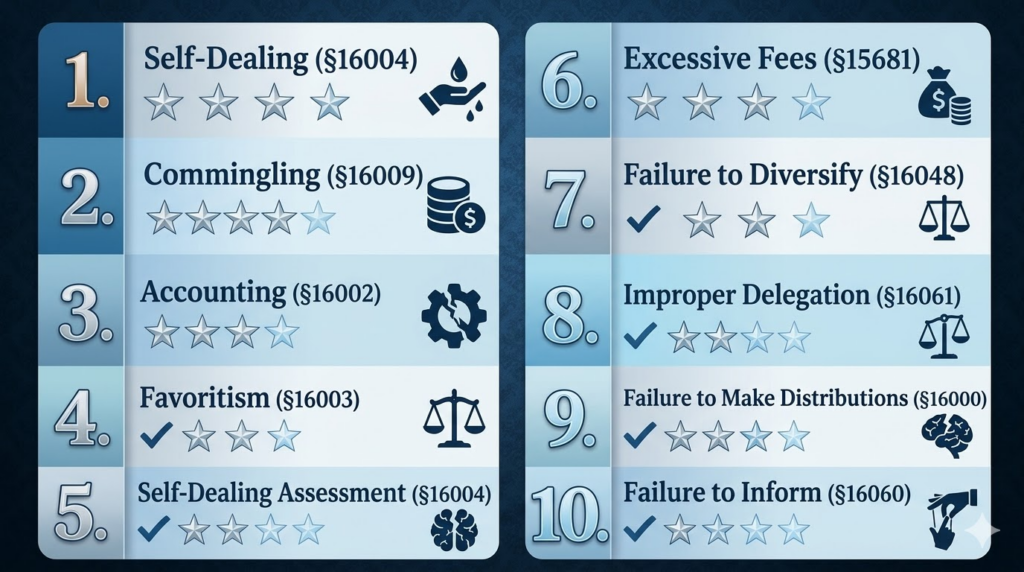
The 10 Most Common Fiduciary Duty Violations
Each of the following violations is tied to a specific Probate Code section. This matters because identifying the exact statutory duty that was breached determines the remedies available and the damages recoverable.
1. Self-Dealing (§16004)
The trustee uses trust property for their own profit or engages in transactions that benefit themselves at the trust’s expense. Examples include purchasing trust real estate at below-market value, making loans from the trust to themselves or family members, and hiring their own business to provide services to the trust at inflated rates. Under §16004(a), the trustee has a duty not to use or deal with trust property for any purpose unconnected with the trust.
2. Commingling Trust and Personal Funds (§16009)
The trustee mixes trust assets with their personal assets — depositing trust income into a personal bank account, using a personal brokerage account for trust investments, or failing to maintain separate records. Under §16009, the trustee has a duty to keep trust property separate from other property and to see that trust property is designated as property of the trust. Commingling makes it difficult to trace trust assets and creates opportunities for misappropriation.
3. Failure to Account (§16062)
The trustee ignores the statutory obligation to provide annual accountings to beneficiaries entitled to current distributions, or provides incomplete accountings that do not meet the six-element requirements of §16063. This is one of the most frequently litigated breaches in California trust litigation. When a trustee refuses to account, beneficiaries can force a trust accounting under §17200 and simultaneously seek removal.
4. Imprudent Investment (§16047)
The trustee violates the Prudent Investor Rule by failing to invest trust assets “as a prudent investor would” with “reasonable care, skill, and caution.” In Estate of Giraldin, the California Supreme Court upheld a surcharge exceeding $5 million against a trustee who invested two-thirds of the trust’s assets in a single family startup. The Prudent Investor Rule under §16047 requires diversification, consideration of the beneficiaries’ needs, attention to general economic conditions, and evaluation of the trust portfolio as a whole.
5. Favoritism Among Beneficiaries (§16003 / §16041)
The trustee treats beneficiaries unequally without authorization in the trust instrument. In Estate of Gilmaker, the California Supreme Court held that a trustee who favored one beneficiary over another breached the duty of impartiality under what is now §16003. Under §16041, if a trust has two or more beneficiaries, the trustee must deal impartially with them and must not sacrifice the interests of one beneficiary in favor of another. Common examples include making distributions to one sibling while withholding them from another, or managing trust property primarily for the benefit of the income beneficiary at the expense of the remainder beneficiaries.
6. Excessive Fees (§15681)
The trustee pays themselves compensation that exceeds what is reasonable given the trust’s size, the complexity of administration, and the results achieved. Under §15681, if the trust instrument does not specify the trustee’s compensation, the trustee is entitled to reasonable compensation. What constitutes “reasonable” is evaluated by the court and benchmarked against professional trustee fee schedules. A family member trustee who charges 3% of trust assets annually for minimal administrative work will face scrutiny.
7. Failure to Make Distributions (§16000)
The trustee delays or refuses to distribute trust assets to beneficiaries who are entitled to receive them under the trust’s terms. This violation of §16000 — the duty to administer the trust according to its terms — is especially common when a sibling-trustee controls distributions to other siblings. Beneficiaries who are entitled to mandatory distributions have an immediate right to petition the court for an order compelling distribution. Proper trust administration requires timely distributions, accurate record-keeping, transparent communication, and beneficiaries can hold trustees accountable when any of these duties are ignored.
8. Failure to Diversify (§16048)
The trustee concentrates trust assets in a single investment, asset class, or geographic location without a documented reason for doing so. Under §16048, the trustee has a duty to diversify the investments of the trust unless, under the circumstances, it is prudent not to do so. The Legacy Lawyers secured a $4.7 million judgment in Los Angeles Superior Court against a trustee who maintained 85% of a $12 million trust in three Beverly Hills properties from 2018 to 2023 without diversifying.
9. Improper Delegation (§16012)
The trustee delegates duties that should be performed personally, or fails to exercise reasonable oversight over delegated functions. Under §16012, a trustee may delegate investment and management functions but must exercise reasonable care, skill, and caution in selecting the agent, establishing the scope of the delegation, and reviewing the agent’s performance. Handing trust investments to an unqualified friend or failing to monitor a financial advisor’s performance constitutes a breach.
10. Failure to Inform (§16060)
The trustee fails to keep beneficiaries reasonably informed about the trust and its administration. Under §16060, this is a standalone duty — separate from the formal accounting obligation under §16062. It covers informal communications, responses to beneficiary inquiries, and proactive disclosure of material events affecting the trust. A trustee who goes silent for months after a triggering event, refuses to return phone calls, or provides evasive answers to direct questions about trust finances is violating §16060.
How Courts Calculate Surcharge Damages
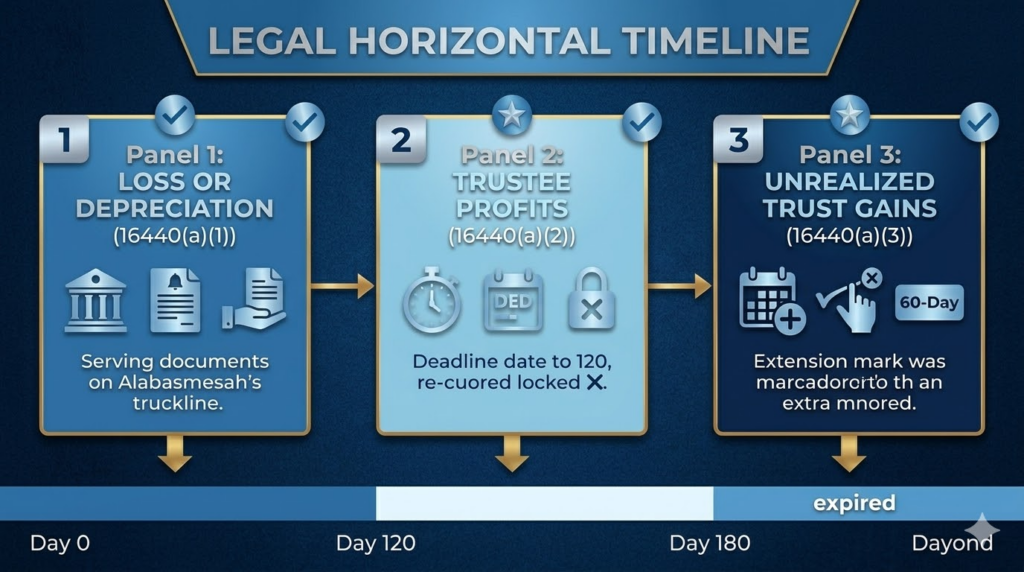
When a trustee breaches their fiduciary duty, Probate Code §16440 provides the framework for calculating damages. The trustee is personally chargeable with whichever of the following is appropriate under the circumstances:
The first measure is any loss or depreciation in the value of the trust estate resulting from the breach, plus interest. If a trustee’s imprudent investment caused the trust to lose $500,000, the trustee owes $500,000 plus statutory interest from the date of the loss.
The second measure is any profit the trustee made through the breach, plus interest. If a trustee purchased trust property for themselves at a below-market price and later sold it at fair market value, the trustee must disgorge the profit — regardless of whether the trust suffered a net loss. This is a disgorgement remedy: the principle is that a fiduciary must never profit from their breach, even if the trust was not directly harmed.
The third measure is any profit that would have accrued to the trust estate if the loss of profit is the result of the breach. If a trustee’s failure to invest trust funds cost the trust $200,000 in returns that a prudent portfolio would have generated, the trustee owes $200,000 plus interest.
Under §16440(b), the court retains discretion to excuse a trustee in whole or in part if the trustee acted reasonably and in good faith under the circumstances. This “good faith” defense is narrow — it protects trustees who made honest errors of judgment, not trustees who acted in self-interest or ignored their duties.
Beyond surcharge, additional remedies under §16420 include compelling the trustee to perform their duties, enjoining future breaches, appointing a receiver or temporary trustee, tracing wrongfully disposed trust property and recovering it or its proceeds, and imposing an equitable lien or constructive trust on assets. And under §17211(b), if the court finds the trustee contested the petition without reasonable cause and in bad faith, the court may award the petitioner’s attorney’s fees.
When the breach rises to the level of bad faith — intentional misconduct rather than negligence — Probate Code §859 double damages may apply on top of all other remedies, requiring the trustee to pay twice the value of any property wrongfully taken, concealed, or disposed of.
Statute of Limitations: Deadlines That Govern Your Right to Act
Multiple overlapping deadlines apply to breach of fiduciary duty claims. Missing any one of them can eliminate a claim entirely.
For breach of fiduciary duty, the general statute of limitations is four years from the date the breach is discovered or reasonably should have been discovered. This discovery rule is critical: if a trustee conceals a breach — by refusing to account, for example — the clock may not start until the beneficiary learns of the misconduct.
For fraud-based claims, the statute of limitations is three years under Code of Civil Procedure §338(d), also subject to a discovery rule.
For claims revealed by a trust accounting, the limitations period is three years from the date the beneficiary receives the accounting or report disclosing facts giving rise to the claim, as stated in §16063(a)(6). This is why trustees who refuse to account are effectively preventing the statute of limitations from ever starting — and why courts compel compliance.
For trust contests based on capacity, undue influence, or fraud, the deadline is 120 days from the trustee notification under §16061.7 — an entirely separate timeline from breach of fiduciary duty claims.
The interaction between these deadlines creates strategic complexity. A beneficiary who has missed the 120-day trust contest deadline may still have viable breach of fiduciary duty claims with a four-year window. Identifying which claims survive — and which deadlines apply to each — is one of the most consequential evaluations in trust litigation.
When Breach Becomes Personal Liability
A common misconception is that trust litigation is only about trust assets. In reality, when a trustee breaches their fiduciary duty, their personal assets are at risk. Under §16440, surcharge damages are assessed against the trustee personally — not against the trust. The trustee must pay from their own funds.
If the trustee commingled trust and personal assets, the court can impose a constructive trust on the mixed assets under §16420(a)(8), giving beneficiaries priority claims. If the trustee transferred trust property to a third party, the court can trace the property and recover it or its proceeds under §16420(a)(9). And if the trustee acted with fraud, malice, or oppression, punitive damages may be available under Civil Code §3294 — in addition to the surcharge, disgorgement, and double damages.
The practical consequence: a trustee who self-deals, conceals assets, or refuses to account is not just risking removal from office. They are risking their personal savings, real estate, and financial future.
Conclusion
In Estate of Gilmaker, the California Supreme Court established that a trustee who favors one beneficiary over another has breached the duty of impartiality and must be surcharged for the resulting harm. In Estate of Giraldin, the court upheld a surcharge exceeding $5 million for a single imprudent investment. These outcomes reflect the core principle of California trust law: the fiduciary duty is absolute, violations carry personal liability, and courts have broad authority to make beneficiaries whole.
If you suspect a trustee has violated their fiduciary obligations — through self-dealing, concealment, imprudent investments, failure to account, or any of the other violations described above — the law provides clear remedies. But those remedies are governed by strict statutes of limitations, and every day a breach continues is a day the trust loses value that may never be recovered.
Call The Legacy Lawyers at (800) 840-1998 to schedule a free consultation. Our trust litigation team will evaluate the evidence, identify which fiduciary duties were breached, calculate the potential surcharge damages, and outline the fastest path to holding the trustee personally accountable.
FAQ SECTION
Q: What is breach of fiduciary duty by a trustee in California?
A: It occurs when a trustee violates any of the duties imposed by the California Probate Code — including loyalty (§16002), care (§16040), impartiality (§16003), prudent investment (§16047), and transparency (§16060). The fiduciary duty is the highest standard of responsibility under California law.
Q: Can a trustee be held personally liable for breach of fiduciary duty?
A: Yes. Under Probate Code §16440, a trustee who breaches their duties is personally chargeable for any losses to the trust, any profits the trustee gained from the breach, and any profits the trust would have earned absent the breach — all plus interest.
Q: What is the statute of limitations for suing a trustee in California?
A: Four years from the date the breach is discovered for breach of fiduciary duty claims. Three years from discovery for fraud claims. Three years from receipt of a trust accounting for claims revealed by that accounting. The 120-day trust contest deadline applies only to challenges to the trust’s validity, not to breach claims.
Q: What damages can I recover for a trustee’s breach?
A: Under §16440, recoverable damages include trust losses plus interest, disgorgement of the trustee’s profits, and lost profits the trust would have earned. Additional remedies include trustee removal (§15642), constructive trusts, equitable liens, attorney’s fees (§17211(b)), and §859 double damages for bad faith misconduct.
Q: What are the most common trustee breaches in California?
A: The most frequently litigated breaches are self-dealing (§16004), failure to account (§16062), imprudent investment (§16047), favoritism among beneficiaries (§16003), excessive compensation (§15681), and failure to keep beneficiaries informed (§16060).
DISCLAIMER
This article references publicly available information including California Probate Code sections 16000, 16002, 16003, 16004, 16009, 16012, 16040, 16041, 16047, 16048, 16060, 16062, 16063, 15642, 15681, 16420, 16440, 17200, 17211, and 859; Civil Code §3294; the California Supreme Court decisions in Estate of Gilmaker (1962) 57 Cal.2d 627 and Estate of Giraldin; and statutory analysis published by FindLaw, Justia, Hackard Law, Gokal Law Group, The Grossman Law Firm, and Casiano Law, dated 1962–2026.
All statutory citations are from the current California Probate Code as published by the California Legislative Information website. Results described are specific to the statutes, cases, and procedures cited and may vary based on jurisdiction, trust terms, and circumstances. For current information about trust litigation services, consult The Legacy Lawyers directly at thelegacylawyers.com.
