

When William Giraldin invested $4 million of his trust’s assets — two-thirds of his entire fortune — into his son Timothy’s startup SafeTzone Technologies Corporation in 2002, the investment became nearly worthless by his death in 2005. The California Supreme Court’s landmark Estate of Giraldin decision established that beneficiaries could sue for breach of fiduciary duty and recover over $5 million in damages — even though the investment was made while the settlor was still alive. That case illustrates a fundamental reality of California trust law: a trustee who mismanages assets, acts in self-interest, or ignores their fiduciary obligations can be removed from office, ordered to account for every transaction, and held personally liable for the losses they caused. Under Probate Code §15642, California courts have broad authority to remove trustee california on any of nine statutory grounds. Here is exactly how the removal process works, when emergency action is available, and what happens to the trust after the trustee is gone.
The Nine Statutory Grounds for Remove Trustee California
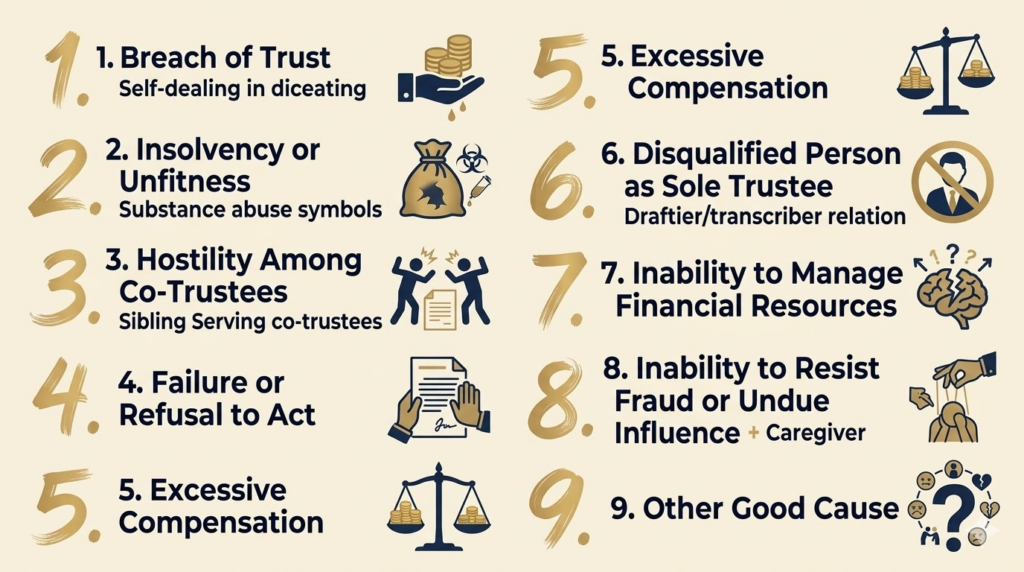
Probate Code §15642(b) enumerates nine grounds on which a court can remove a trustee. These grounds are not exclusive — courts also retain broad equitable power to supervise trust administration, and the ninth ground (“other good cause”) functions as a catch-all that gives judges significant discretion.
1. Breach of Trust (§15642(b)(1))
This is the most common basis for removal. A breach of fiduciary duty encompasses any violation of the trustee’s fiduciary duties, including self-dealing (using trust assets for personal benefit), commingling trust and personal funds, making imprudent investments in violation of the Prudent Investor Rule under §16047, failing to account to beneficiaries, paying themselves excessive fees, or favoring one beneficiary over others. The question for the court is whether the trustee’s conduct harmed the trust or put beneficiaries at unreasonable risk. A single serious breach — such as the $4 million startup investment in Estate of Giraldin — can be sufficient for removal.
2. Insolvency or Unfitness (§15642(b)(2))
A trustee who is insolvent — unable to pay their own debts — poses an obvious risk to trust assets. But “unfitness” extends further. It includes substance abuse that impairs judgment, mental incapacity that prevents competent administration, lack of the knowledge or skill required to manage the trust’s assets, and a demonstrated pattern of poor decision-making. The unfitness standard is broad, and courts evaluate it based on the totality of circumstances.
3. Hostility Among Co-Trustees (§15642(b)(3))
When co-trustees cannot cooperate, trust administration grinds to a halt. If hostility or lack of cooperation among co-trustees impairs the administration of the trust, the court can remove one or more of them. This ground frequently arises in family trusts where siblings serve as co-trustees and disagree about investment strategy, distribution timing, or the sale of trust property.
4. Failure or Refusal to Act (§15642(b)(4))
A trustee who simply stops performing their duties — refusing to make distributions, declining to respond to beneficiary communications, or neglecting to file required tax returns — can be removed for failure to act. This ground overlaps significantly with the duty to account: if a trustee ignores written demands for an accounting for 60 days, the beneficiary can both force a trust accounting under §17200 and simultaneously petition for removal.
5. Excessive Compensation (§15642(b)(5))
Trustees are entitled to reasonable compensation, but when fees become excessive, removal is warranted. The court evaluates whether the trustee’s compensation is reasonable in light of the trust’s size, the complexity of administration, the trustee’s skill and experience, and the results achieved. A family member trustee who pays themselves $200,000 per year to manage a $1 million trust will face serious scrutiny.
6. Disqualified Person as Sole Trustee (§15642(b)(6))
This ground targets a specific and dangerous scenario: when the sole trustee is a “disqualified person” under §21380 — meaning the person who drafted the trust, transcribed it while in a fiduciary relationship with the settlor, or served as a care custodian of a dependent adult. Unless the court finds the designation was consistent with the settlor’s intent and was not the product of fraud or undue influence, such a trustee must be removed. Any waiver of this provision by the settlor is void as against public policy.
7. Inability to Manage Financial Resources (§15642(b)(7))
Under Part 17 of Division 2 (commencing with §810), if the trustee is substantially unable to manage the trust’s financial resources or execute their duties, the court can order removal. This ground often applies when a trustee has developed cognitive impairment due to age or illness. When the trustee also holds the power to revoke the trust, the standard is higher: substantial inability cannot be proven solely by isolated incidents of negligence or improvidence.
8. Inability to Resist Fraud or Undue Influence (§15642(b)(8))
If the trustee is substantially unable to resist fraud or undue influence — for example, an elderly trustee being manipulated by a caregiver or family member — the court can remove them. If the trustee is a vulnerable adult being exploited, a conservatorship lawyer in California can petition the court for protective orders alongside the removal action. This ground is distinct from removing the person exerting the influence; it focuses on the trustee’s vulnerability. The same heightened standard applies when the trustee holds revocation power.
9. Other Good Cause (§15642(b)(9))
This catch-all provision gives courts the flexibility to remove a trustee whenever circumstances warrant it, even if the conduct does not fit neatly into the other eight categories. Courts have used “other good cause” to remove trustee california whose relationship with beneficiaries has deteriorated so completely that effective administration is impossible, or where a change in circumstances (such as the trustee moving out of state) makes continued service impractical.
Emergency Suspension: Protecting Trust Assets Before the Hearing
In many cases, waiting months for a removal hearing would allow a bad trustee to dissipate, hide, or further mismanage trust assets. Probate Code §15642(e) provides an emergency remedy.
Under §15642(e), if the court determines that trust property or the interests of a beneficiary may suffer loss or injury pending a decision on the removal petition, the court can take immediate action on its own motion or on petition of a co-trustee or beneficiary. The available emergency relief includes compelling the trustee to surrender trust property to a co-trustee, a receiver, or a temporary trustee, and suspending some or all of the trustee’s powers to the extent the court deems necessary.
In practice, this means filing an ex parte application — a request for same-day or next-day court action without the usual notice period. The Legacy Lawyers‘ litigation team has filed emergency suspension petitions at Stanley Mosk Courthouse in Los Angeles, the Lamoreaux Justice Center in Orange County, and Superior Courts throughout Southern California. When circumstances demand it — such as discovery that a trustee is actively transferring assets out of the trust or liquidating property below market value — the petition can be prepared and filed within 24 to 48 hours.
The temporary suspension remains in effect pending the full removal hearing, which is typically scheduled 30 to 60 days later. During this period, a temporary trustee or receiver manages the trust, preserving assets and maintaining the status quo until the court makes a final determination.
Who Can Petition to Remove a Trustee
Under §15642(a), the following parties have standing to petition for trustee removal:
- The settlor (the person who created the trust), if still alive and competent
- Any co-trustee who is currently serving
- Any beneficiary of the trust, including remainder beneficiaries
- The court itself, on its own motion
- The Attorney General, if the trust involves charitable purposes
Additionally, a trustee can be removed “in accordance with the trust instrument.” Many trusts include provisions allowing a majority of beneficiaries, a trust protector, or a designated individual to remove and replace the trustee without court involvement. Reviewing the trust document for these provisions is always the first step — it is faster and less expensive than a court petition if the mechanism exists.
The Removal Petition Process: What The Legacy Lawyers Does in Court
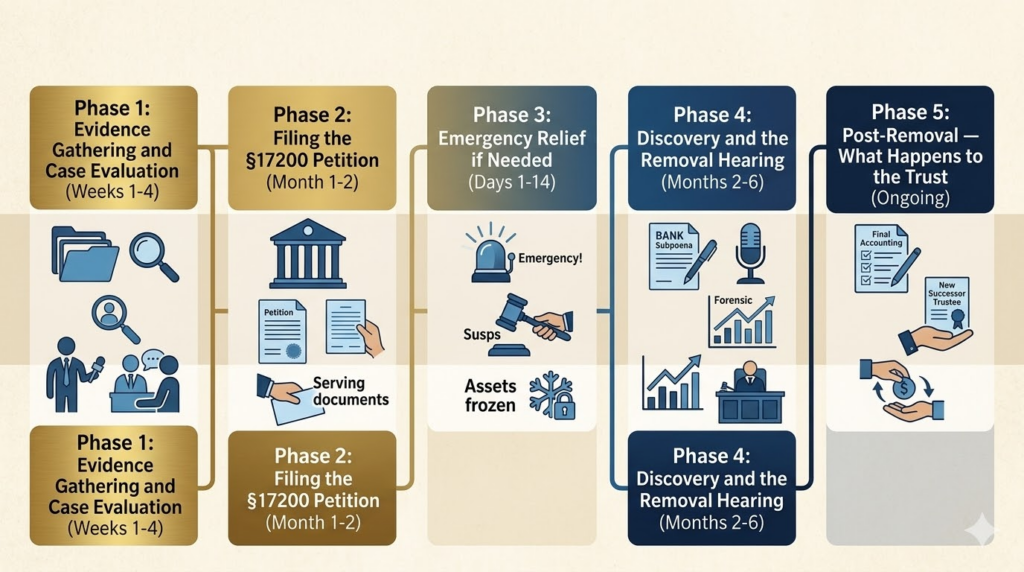
Phase 1: Evidence Gathering and Case Evaluation (Weeks 1–4)
Before filing, The Legacy Lawyers’ litigation team conducts a thorough investigation. This includes reviewing the trust document and all amendments, obtaining whatever financial records the trustee has provided (or failed to provide), pulling publicly recorded property transfers from county recorder offices, and interviewing witnesses who can testify about the trustee’s conduct. The goal is to identify which of the nine statutory grounds apply and to assess whether the evidence supports an emergency suspension petition.
Phase 2: Filing the §17200 Petition (Month 1–2)
The removal petition is filed under Probate Code §17200 in the Superior Court of the county where the trust is administered. The petition identifies the statutory grounds under §15642(b), describes the specific facts supporting each ground, and requests relief — typically trustee removal, the appointment of a successor trustee, a full accounting by the removed trustee, and a surcharge for any losses caused by the trustee’s conduct. The petition must be served on the trustee and all interested parties, including all other beneficiaries.
Phase 3: Emergency Relief if Needed (Days 1–14)
If trust assets are at immediate risk, the team files an ex parte application under §15642(e) simultaneously with or shortly after the removal petition. This can result in a same-day or next-day court order suspending the trustee’s powers and appointing a temporary trustee or receiver.
Phase 4: Discovery and the Removal Hearing (Months 2–6)
Discovery in removal cases focuses on the trustee’s financial records, communications with beneficiaries, and any transactions that support the alleged breaches. Depositions, bank subpoenas, and forensic accounting analysis build the evidentiary foundation. The removal hearing itself is typically a one- to two-day bench trial before a probate judge. The petitioner presents evidence, the trustee responds, and the court determines whether grounds for removal exist.
The Legacy Lawyers reports that approximately 85% of their trustee removal cases settle before the hearing. Settlement terms typically include the trustee’s voluntary resignation, a negotiated full accounting, a damage payment for losses caused during the trustee’s tenure, and reimbursement of the petitioner’s attorney’s fees and costs.
Phase 5: Post-Removal — What Happens to the Trust (Ongoing)
Once the court orders removal (or the trustee resigns), three things must happen. First, the removed trustee must prepare and submit a final accounting covering their entire tenure, compliant with §16063 requirements. Second, a successor trustee must be appointed — following the trust’s succession provisions under §15660(b), by agreement of adult beneficiaries under §15660(c), or by court appointment under §15660(d). The court gives consideration to nominations by beneficiaries who are 14 years of age or older. Third, the trust property must be transferred from the removed trustee to the successor.
Surcharge: Recovering Losses from the Removed Trustee
Removal alone does not compensate beneficiaries for the damage already done. Under Probate Code §16420, a trustee who commits a breach of trust is personally liable for the greater of the loss or depreciation in trust assets resulting from the breach, any profit the trustee made from the breach, or any profit that would have accrued to the trust absent the breach.
In Estate of Giraldin, the California Supreme Court upheld a surcharge of over $5 million against a trustee who invested two-thirds of the trust’s assets in a single family startup — a clear violation of the Prudent Investor Rule under §16047. The surcharge covered both the direct losses from the failed investment and the profits the trust would have earned had the assets been prudently invested.
When the trustee’s conduct rises to the level of bad faith — as opposed to mere negligence — Probate Code §859 double damages may also apply. This means the court can order the removed trustee to pay twice the value of any property they wrongfully took, concealed, or disposed of, on top of returning the property itself. For a deeper analysis of how §859 works, see our guide on Probate Code §859 double damages for bad faith misappropriation.
The Bad Faith Filing Protection: §15642(d)
Trustee removal is a serious remedy, and California law includes a safeguard against abusive petitions. Under §15642(d), if the court finds that the petition for removal was filed in bad faith and that removal would be contrary to the settlor’s intent, the court may order the petitioner to pay all or part of the costs of the proceeding, including reasonable attorney’s fees.
This provision protects legitimate trustees from frivolous removal attempts. But it also underscores the importance of thorough case evaluation before filing. Every removal petition filed by The Legacy Lawyers is backed by documented evidence tying specific trustee conduct to specific statutory grounds — precisely to ensure the petition is well-founded and not subject to a §15642(d) fee-shifting order.
Conclusion
When William Giraldin’s son invested $4 million of trust assets in a company that became worthless, the California Supreme Court held the trustee personally liable for over $5 million in damages. That outcome reflects the core principle behind Probate Code §15642: trustees who breach their duties, harm beneficiaries, or prove unfit to serve can and should be removed — and they must answer for the losses they caused.
The removal process begins with identifying which of the nine statutory grounds apply, assembling the evidence, and filing a §17200 petition in probate court. When trust assets are at immediate risk, emergency suspension under §15642(e) can freeze the trustee’s powers within days. And after removal, surcharge under §16420 and double damages under §859 ensure that beneficiaries can recover what was lost.
If a trustee is mismanaging your family’s trust, refusing to account, or acting in their own self-interest, the law provides clear remedies. But those remedies require action — and the longer a bad trustee operates, the more difficult it becomes to trace and recover misappropriated assets.
Call The Legacy Lawyers at (800) 840-1998 to schedule a free consultation. Our trust litigation team will evaluate the evidence, determine which statutory grounds apply, and outline the fastest path to protecting your inheritance.
FAQ SECTION
Q: What are the grounds for removing a trustee in California?
A: Probate Code §15642(b) lists nine grounds: breach of trust, insolvency or unfitness, hostility among co-trustees, failure to act, excessive compensation, disqualified person serving as sole trustee, inability to manage finances, inability to resist fraud or undue influence, and other good cause.
Q: How long does it take to remove a trustee in California?
A: Emergency suspension under §15642(e) can freeze a trustee’s powers within days through an ex parte petition. The full removal hearing is typically set 30 to 60 days after filing. Approximately 85% of cases settle before the hearing, with total timelines averaging 3 to 6 months.
Q: Can a trustee be removed without going to court?
A: Yes, if the trust document provides a mechanism for removal — such as a vote by a majority of beneficiaries or designation of a trust protector with removal authority. Review the trust instrument first. Court involvement is required only when the trust does not provide an alternative method.
Q: What happens after a trustee is removed?
A: The removed trustee must prepare a final accounting under §16063. A successor trustee is appointed following the trust’s terms, by beneficiary agreement, or by court order under §15660. Trust property is transferred to the successor, and the removed trustee may be surcharged for losses under §16420.
Q: Can I recover money lost by a bad trustee?
A: Yes. Under Probate Code §16420, a trustee who breaches their duties is personally liable for the losses they caused. If the trustee acted in bad faith, §859 allows the court to impose double damages — twice the value of misappropriated property. In Estate of Giraldin, the California Supreme Court upheld a surcharge exceeding $5 million.
DISCLAIMER
This article references publicly available information including California Probate Code sections 15642, 15660, 16047, 16063, 16420, 17200, 21380, and 859; the California Supreme Court decision in Estate of Giraldin; and statutory analysis published by FindLaw, Justia, Trust Law Partners LLP, and the Stimmel Law firm, dated 2005–2026. All statutory citations are from the current California Probate Code as published by the California Legislative Information website. Results described are specific to the statutes, cases, and procedures cited and may vary based on jurisdiction, trust terms, and circumstances. For current information about trust litigation services, consult The Legacy Lawyers directly at thelegacylawyers.com.